Tools and Calculators
Daily Drawdown Calculator for Prop Firm Traders
Learn how prop firm daily drawdown limits work, balance-based vs equity-based calculations, and how to track your own real-time buffer.
Daily Drawdown Calculator for Prop Firm Traders
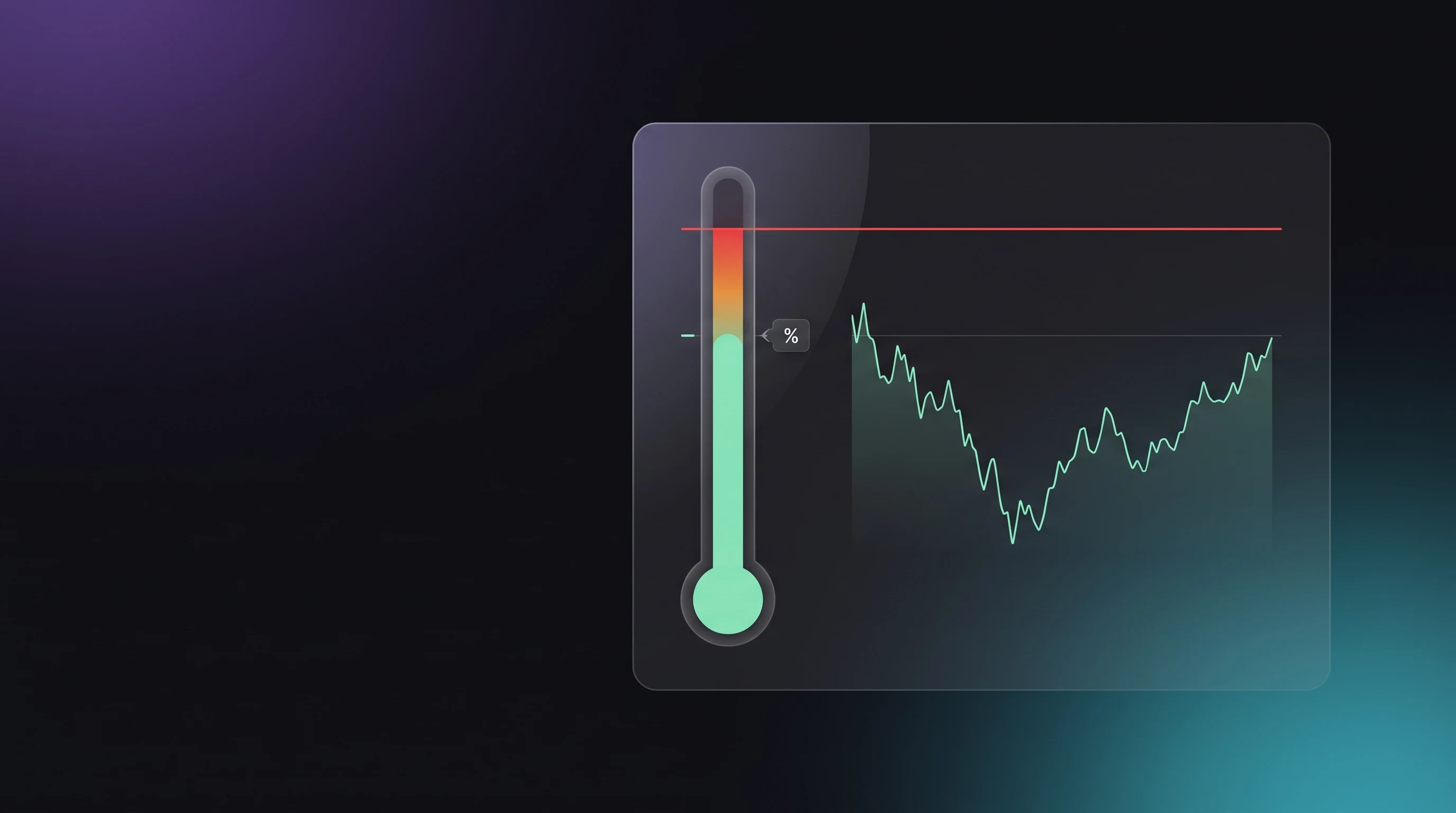
Most prop firm traders can recite their profit target from memory. Far fewer can say, at any given moment mid-session, exactly how much of their daily drawdown allowance they’ve already used. That gap matters, because a daily drawdown breach ends an account instantly, regardless of how good the account’s overall statistics look. This article explains what a daily drawdown limit actually measures, the two different ways firms calculate it, and how to track your own number in real time instead of finding out the hard way.
What a Daily Drawdown Limit Actually Measures
A daily drawdown limit caps how much an account is allowed to lose within a single trading day, expressed as a percentage of a baseline value for that day. If losses on a given day reach that percentage, the account breaches — typically immediately, and typically regardless of whether the account is otherwise profitable overall.
This is a different rule from the consistency requirement covered in a companion piece on the prop firm consistency calculator: a consistency rule affects whether a payout gets approved after the fact, while a daily drawdown limit can end the account outright, on any day, independent of the account’s total profit or loss.
Balance-Based vs Equity-Based Daily Drawdown
The single most important detail in how a firm calculates daily drawdown is whether it uses balance or equity as the baseline and the running measurement, and this detail varies by firm.
Balance-based calculations typically only count realized results — profit or loss from trades that have actually been closed. An open losing position sitting well underwater does not count against a balance-based limit until it is closed.
Equity-based calculations include floating, unrealized profit and loss from currently open positions, updated in real time. A large open loss can push equity-based drawdown toward the limit even while every trade for the day is technically still open and could recover.
These two methods can produce very different pictures of how close an account actually is to breaching on any given day. Which method applies is determined entirely by the specific firm’s rules — this is exactly the kind of detail worth confirming directly rather than assuming.
The Daily Drawdown Formula
Once the baseline method is known, the calculation itself is simple:
Daily drawdown used = (Day-start baseline − current balance or equity) ÷ Day-start baseline × 100
Remaining buffer = Firm’s daily drawdown limit (%) − Daily drawdown used (%)
The “day-start baseline” resets at the start of each new trading day, using whatever balance or equity the account showed at that reset point — which is itself firm-specific (some firms use midnight server time, others align it to a specific market session).
Step-by-Step: How to Calculate Your Real-Time Daily Drawdown
- Confirm which measurement method your firm uses — balance-based or equity-based — from your account’s specific rules.
- Record your day-start baseline the moment each new trading day begins, before taking any trades.
- Track your running balance or equity throughout the day, matching whichever method applies.
- Calculate the percentage drop from the day-start baseline using the formula above, at any point you want to check your standing.
- Subtract that number from your firm’s stated daily drawdown limit to see your remaining buffer before a breach.
Doing this by hand for every open position, every time it moves, is not realistic during active trading hours. This is a case where a running, automatically updated number is far more useful than a number recalculated occasionally by hand — and it’s a natural companion to a trading journal that’s already logging a day-start balance and an end-of-day result, since the same daily figures feed both.
A Worked Example
Suppose a trader’s day-start balance is $50,000, and their firm enforces a 5% daily drawdown limit measured on an equity basis. Partway through the day, with two open positions currently showing a combined floating loss, account equity sits at $47,800.
Daily drawdown used = ($50,000 − $47,800) ÷ $50,000 × 100 = 4.4%
Remaining buffer = 5% − 4.4% = 0.6%
At this point the trader has just 0.6% of additional equity decline available before breaching for the day — a very different situation than the account’s closed-trade balance alone might suggest, and a detail that would be easy to miss without watching equity specifically.
Why Floating Losses Catch Traders Off Guard
The scenario above is exactly why equity-based limits surprise traders more often than balance-based ones. A trader glancing only at realized balance can feel like the day is fine, while open positions are quietly consuming most of the day’s available buffer. By the time those positions are closed, whether at a loss or a partial recovery, the buffer available for any further trading that day may already be gone.
Checking floating equity against the daily limit, not just closed balance, is the specific habit that prevents this kind of surprise — and it only matters at all under an equity-based rule, which is exactly why confirming which method applies to your account matters as a first step, not an afterthought.
Using the Remaining Buffer to Size Decisions, Not to Chase It Back
A remaining-buffer number is most useful as an input into ordinary risk decisions already being made, not as a target to defend at all costs:
- Check remaining buffer before opening a new position, the same way position size and stop distance are already checked, so a new trade’s maximum possible loss is compared against what’s actually left for the day.
- A shrinking buffer is information, not a reason to change strategy mid-day. Trading smaller or skipping a marginal setup when buffer is low is a sizing decision, not a signal-based one.
- Resist the urge to trade more aggressively specifically to recover a buffer that’s already shrunk. This is one of the more common ways a day that started with a small drawdown ends in a full breach.
None of this is about predicting whether the next trade wins or loses. It’s about knowing the actual number left before a single more losing trade ends the day for the account, and letting that number inform ordinary position-sizing decisions already being made.
What This Calculator Cannot Tell You
A daily drawdown calculator answers a specific, mechanical question: given a starting baseline, a current balance or equity figure, and a stated limit, how much buffer is left right now. It has clear limits:
- It cannot tell you which measurement method — balance or equity — your specific firm actually uses. That comes only from your firm’s own rules.
- It cannot predict how any open position will move for the remainder of the day.
- It cannot guarantee that staying within the daily limit will prevent a breach of some other account rule, since daily drawdown is usually just one of several rules an account has to satisfy at once.
- It is not a substitute for reading your firm’s actual risk rules for your specific account type.
Its value is in making a number that changes constantly, and that is genuinely tedious to recalculate by hand throughout a trading day, available at a glance.
Where This Fits in the Tools Series
This calculator is one of several planned for this part of the site, alongside the Prop Firm Consistency Calculator pillar it supports. Related tools still to come include a Lot Size Calculator, a Risk-to-Reward Calculator, and a Profit Target Calculator — each one answering a single, specific numeric question rather than trying to double as a general strategy guide.
How PropLog AI Supports This
PropLog AI’s account tracking is designed to keep a running daily drawdown figure visible throughout the trading day, calculated against whichever baseline method matches the trader’s own account rules, rather than requiring a manual recalculation every time a position moves. It shows the remaining buffer as a plain number, so it can be checked before a new position is opened the same way position size or stop distance already would be.
It does not know a specific firm’s exact rule set in advance — that still comes from the trader’s own account terms — and it does not forecast how any open position will move next. Its role stops at keeping the math accurate and current, based on the trader’s own account activity.
Conclusion
A daily drawdown limit is one of the few prop firm rules that can end an account in a single session, which makes knowing your real-time number more useful than knowing it only after the fact. The calculation is simple once the baseline method — balance or equity — is confirmed for your specific account, but tedious to track by hand while trades are still open. Checking remaining buffer before a new position, rather than after a breach, is the practical habit this calculator is built to support.
Start your trading journal
Track trades, understand your psychology, and get personalized AI coaching. No signals, no financial advice — just better self-review from your own data.
Get Started Free