Prop Firm Expenses and ROI
The Complete Guide to Tracking Your Prop Firm Expenses
Prop firm challenges, resets, activations — the costs add up fast. Here's how to track everything so you know your real profitability.
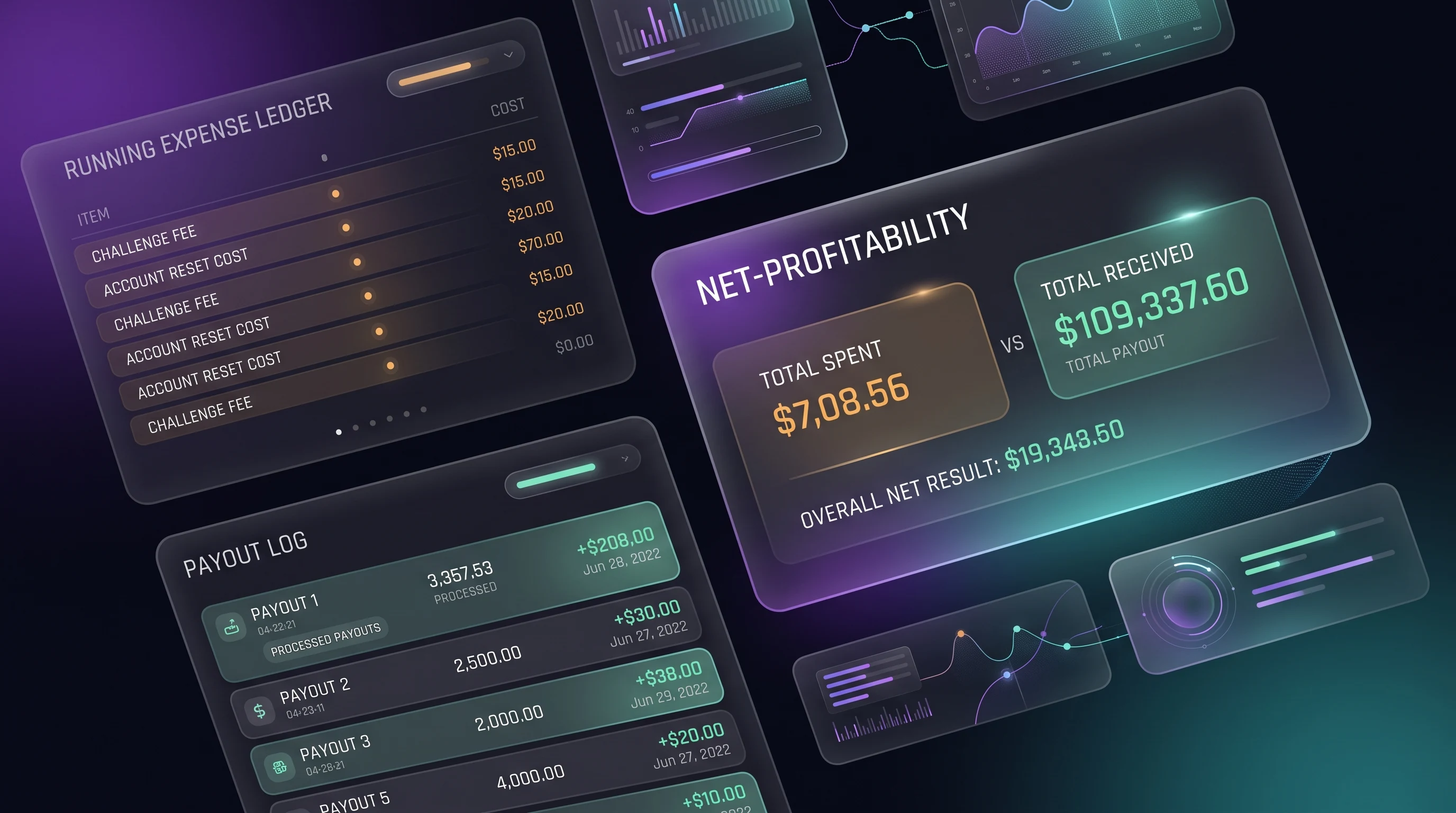
Here’s a question most prop firm traders never ask themselves: “Am I actually profitable after expenses?”
You might have passed three challenges this year and received two payouts. That sounds great. But how much did you spend getting there? Those challenge purchases, resets, activation fees, and monthly data subscriptions add up faster than you think.
The Hidden Cost of Prop Firm Trading
Let’s do some honest math.
A typical prop firm journey might look like this:
| Expense | Cost |
|---|---|
| First challenge attempt | $250 |
| Second attempt (failed) | $250 |
| Third attempt (passed) | $250 |
| Activation fee | $150 |
| Monthly data fee (6 months) | $300 |
| Second account challenge | $500 |
| Reset on second account | $100 |
| Total spent | $1,800 |
If your first payout was $1,200 — congratulations, you’re still $600 in the hole.
This isn’t to discourage you. It’s to give you a clear picture. You can’t optimize what you don’t measure. For a fuller review process, pair expense tracking with a prop firm trading journal so you can compare costs, behavior, and rule adherence together.
What to Track
Every prop firm expense falls into one of these categories:
Challenge Purchases
- New account challenges (the initial purchase)
- Account size matters — a $200K account costs more than $50K
Resets and Renewals
- Failed challenge resets (usually 10-20% of the original cost)
- Account renewals if your challenge period expires
Activation Fees
- Some firms charge a one-time activation fee when you pass the challenge
- This is separate from the challenge cost
Recurring Costs
- Monthly platform or data fees
- Subscription tools you use for trading (not strictly a prop firm expense, but relevant to your true cost)
Payouts
- Track every payout received
- Note the firm, amount, and date
- This is your revenue against all those expenses
The Metric That Matters: Net Profitability
Your net profitability is simple:
Total Payouts − Total Expenses = Net Profit
If that number is negative, you’re not profitable yet — regardless of what your trading stats say. For a more complete version of this calculation — one that accounts for every attempt, including the failed ones, rather than just the challenge that eventually passed — see Prop Firm ROI Calculator: Fees, Payouts, and Failed Challenges.
This doesn’t mean you’re a bad trader. It means you need a clear picture of where your money is going so you can make smarter decisions about which accounts to run and when to cut losses on underperforming firms.
Smart Expense Decisions
Once you track everything, you can start making data-driven decisions:
Which firm has the best ROI? If Firm A costs $500 per attempt and you’ve failed twice, that’s $1,000 invested. If Firm B costs $250 and you passed on the first try, the math is obvious.
When to stop resetting. If you’ve reset an account three times, you’ve spent more than a fresh challenge would cost. Time to re-evaluate.
Account size sweet spot. Bigger accounts have bigger payouts, but the challenge costs more and the stakes feel higher. Find the size where you trade your best.
Seasonal patterns. Do you fail more challenges during certain months? Maybe the market conditions were tough, or maybe you were distracted. Your expense log tells the story.
Start Tracking Today
The best time to start tracking expenses was when you bought your first challenge. The second-best time is now.
Keep it simple: date, firm, expense type, and amount. Review monthly. Know your true profitability.
Because passing a prop firm challenge feels great. But the only number that matters is what’s left in your pocket after all the costs.
Start your trading journal
Track trades, understand your psychology, and get personalized AI coaching. No signals, no financial advice — just better self-review from your own data.
Get Started Free