AI Trading Coaching
How to Use AI to Improve Trading Discipline Without Taking Trading Advice
A step-by-step process for improving trading discipline with AI review of your own journal data -- without crossing into trade signals or advice.
How to Use AI to Improve Trading Discipline Without Taking Trading Advice
Most people hear “use AI to trade better” and picture a signal feed: a tool that tells you when to enter, when to exit, or which pair is about to move. That version of AI-assisted trading is exactly what a prop firm trader should avoid. There is a second, much narrower use of AI that holds up to scrutiny: using it to strengthen trading discipline by analyzing a trader’s own behavior, not the market. This article walks through that process step by step, and is just as much about where the process should stop as it is about how to start it.
What “Using AI for Discipline” Actually Means
Discipline, in a prop firm context, is really just rule adherence under pressure: following the position size you planned, respecting a daily loss limit, skipping a setup that does not meet your own checklist. An AI layer cannot supply that discipline. What it can do is make a trader’s own rule-following behavior easier to see clearly and consistently, which is a very different job from telling a trader what to do next in the market.
That distinction is the boundary in this article’s title, and it is the same boundary laid out more broadly in AI Trading Coach for Prop Firm Traders: What It Should and Should Not Do. “Improve trading discipline” means strengthening a trader’s own process. “Without taking trading advice” means the AI layer never crosses into recommending a trade, an entry, or an exit. Everything below stays on the process side of that line.
Step 1: Build a Data Foundation Worth Analyzing
None of this works without consistent logging. An AI layer has nothing to analyze if setup, planned risk, rule-compliance status, and outcome are not being recorded trade by trade. This is the same foundation described in Best Trading Journal for Prop Firm Traders: specific fields, logged the same way every time, not an occasional note when something goes badly.
A trader who logs inconsistently will get inconsistent, low-confidence output from any AI layer built on top of that data. This step has no shortcut. It is also the step most traders skip, which is part of why AI-assisted discipline review is less common than it should be.
Step 2: Let AI Surface Discipline-Specific Metrics, Not Just P&L
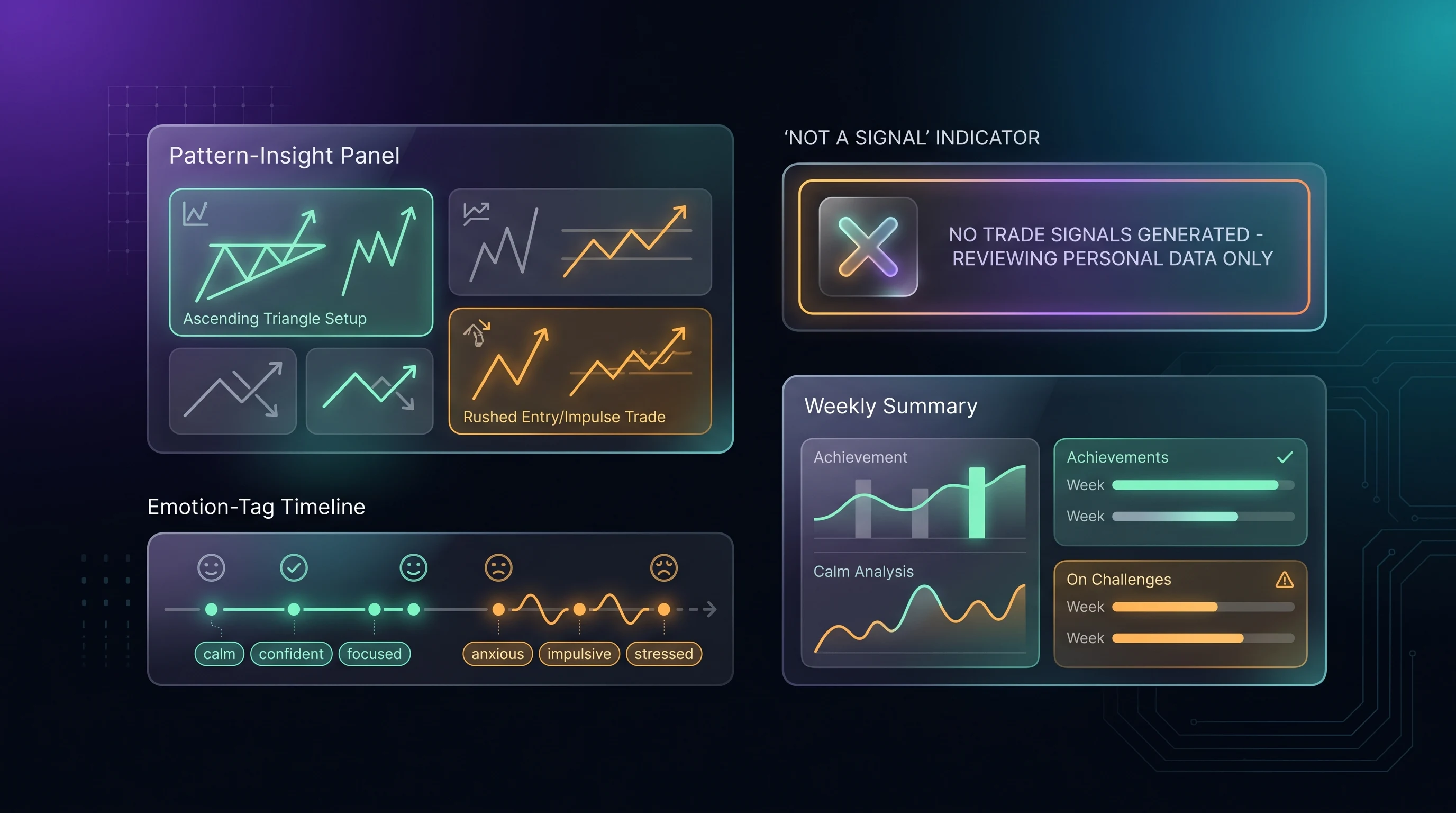
Once logging is consistent, an AI layer can calculate things that are tedious to track by hand: a rolling rule-compliance rate, how that rate changes after a loss versus after a win, which sessions or setups show the lowest adherence, and how often a specific rule gets broken compared to others.
The mechanics behind how a tool actually finds these patterns — correlation between tags and outcomes, clustering by session or setup, sequence detection around trigger events, and outlier flags — are covered in more depth in a companion piece on how an AI trading coach finds patterns in your journal data. What matters for this article is simpler: the output should be a discipline metric, not a market opinion. “Your rule-compliance rate is 58% on trades taken in the last hour of the session” is a discipline metric. “Avoid trading in the last hour” is advice. A good AI layer stops at the first sentence and lets the trader decide what, if anything, the second sentence should be.
Step 3: Turn One Pattern Into One Specific Rule
This is the step that actually produces discipline improvement, and it is a manual step, not an automated one. A vague resolution like “be more careful late in the session” rarely survives contact with a real trading day. A specific, checkable rule does much better.
Using the example above, a specific rule might read: “No new setups after the last 60 minutes of the session unless every item on my entry checklist is marked complete.” That rule can be logged as its own compliance field going forward, which turns a one-time observation into something trackable over time.
The AI layer’s job ends at surfacing the pattern clearly enough for the trader to write a rule like this. Writing the rule, and deciding whether it is the right rule, stays entirely with the trader.
Step 4: Track Compliance With the New Rule, Not Just Results
A common mistake after adopting a new rule is judging it by the very next trade’s outcome. A single winning or losing trade says almost nothing about whether a new discipline rule is working. What matters is the compliance rate with that specific rule over a meaningful number of trades.
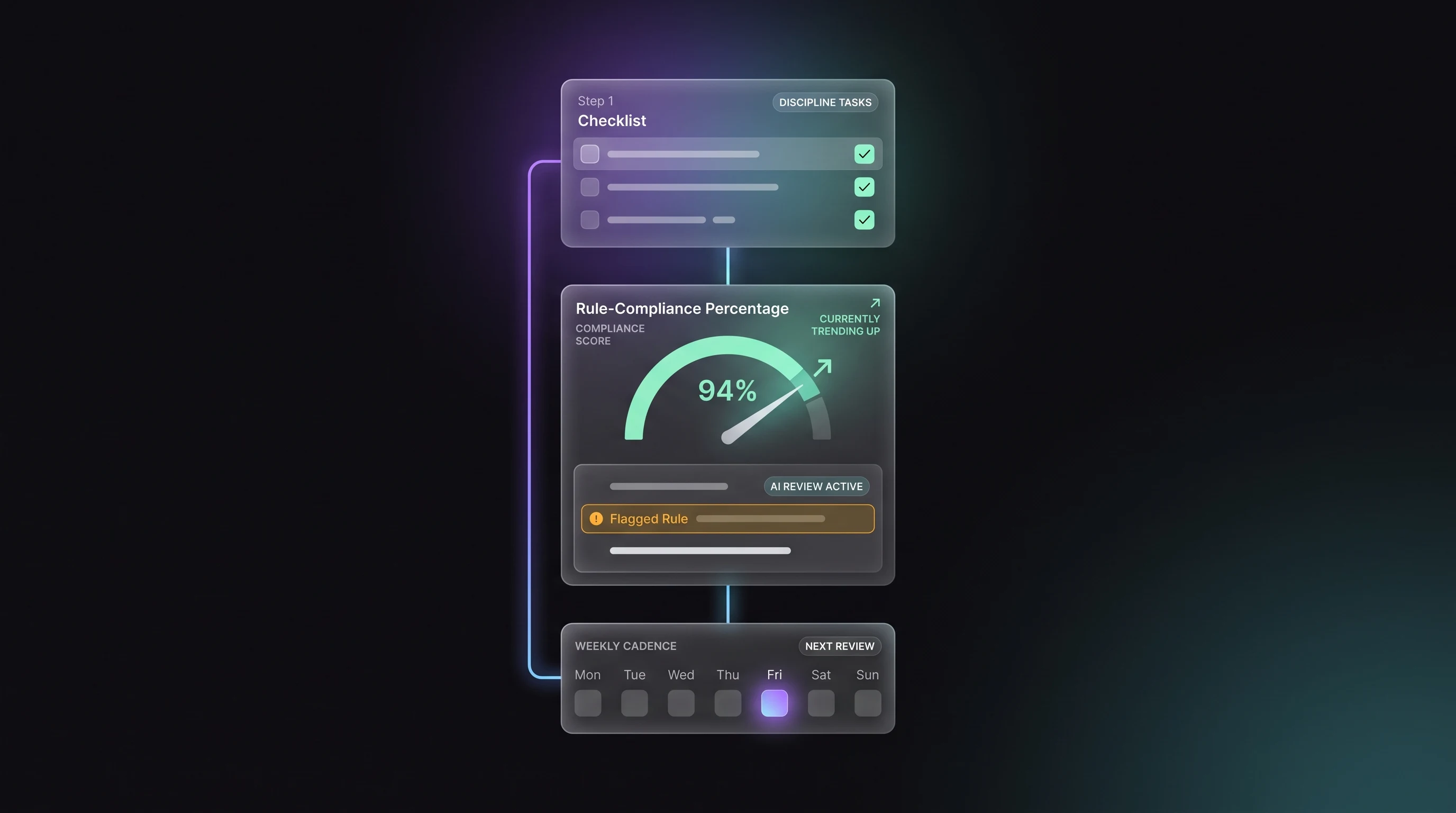
This is where an AI layer earns its place in the process on an ongoing basis, not just as a one-time diagnostic: tracking adherence to the new rule automatically, the same way it tracked the original pattern, so the trader can see a trend rather than reacting to noise. If compliance with the new rule sits at 90% after thirty trades, that is useful information regardless of how those thirty trades individually performed.
Step 5: Review on a Fixed Cadence, Not After Every Trade
Reviewing discipline metrics after every single trade invites overreaction to small samples. A weekly or monthly cadence, similar to the review habits described in the trading journal and discipline system pieces on this site, gives patterns enough trades to become meaningful before any conclusion gets drawn from them.
An AI layer can make this cadence easier to stick to by preparing the summary automatically, so the review itself takes minutes rather than requiring a trader to recompute compliance rates by hand every week.
Where the Line Is: What This Process Should Never Turn Into
Every step above stays inside a specific boundary, and it is worth stating that boundary directly rather than leaving it implied:
- The AI layer should never suggest a specific trade, entry, or exit, at any step in this process.
- It should never imply that following its output guarantees a particular win rate or funded-account outcome.
- It should never blur the difference between “here is a pattern in your own rule-following behavior” and “here is what you should do in the market.”
- It should never replace the trader’s own judgment about which rule to adopt, or whether a pattern is worth acting on at all.
A tool that stays inside these limits is doing discipline-support work. A tool that crosses any of them, no matter how it is marketed, has moved into something closer to unlicensed trading advice — a distinction explored further in a companion piece on why AI trading coaches should not give buy or sell signals in the first place.
A Worked Example From Start to Finish
Consider a trader who has logged 150 trades with session, setup, and rule-compliance tags. An AI layer surfaces that rule-compliance drops to 52% on trades opened in the final hour of the New York session, compared to 81% across all other hours.
The trader reviews this manually and decides the cause is fatigue-driven rule-skipping late in the day, not a flaw in the setup itself. They write a specific rule: no new entries in that final hour unless the full checklist is completed. They start tracking compliance with this exact rule going forward.
After the next 40 trades, the AI layer reports 88% compliance with the new rule. That number, not the win/loss result of any single trade in that window, is the actual measure of whether discipline improved. The trader can now decide, with real data instead of a feeling, whether the new rule is worth keeping as written, adjusting, or dropping.
How Propol AI Coach Supports This Process
Propol AI Coach, built into PropLog AI, is designed to support exactly this loop: surfacing discipline-relevant patterns such as rule-compliance rates by session, setup, or time since a prior loss, and then tracking adherence to whatever specific rule a trader decides to adopt from that pattern. It does not suggest trades, does not issue entry or exit signals, and does not claim that following a surfaced pattern will produce a specific result.
Its role is closer to a compliance tracker built around a trader’s own stated rules than a strategy advisor. The trader remains responsible for deciding which pattern matters, what rule to write in response, and whether that rule is working.
Conclusion
Using AI to improve trading discipline is a five-step loop, not a single feature: build consistent data, surface discipline-specific metrics, turn one pattern into one specific rule, track compliance with that rule rather than short-term results, and review on a fixed schedule instead of after every trade. None of it requires the AI layer to know anything about where the market is headed, and none of it should. The moment an “AI discipline tool” starts suggesting trades instead of tracking rule adherence, it has stopped doing this job and started doing a different, much riskier one.
Start your trading journal
Track trades, understand your psychology, and get personalized AI coaching. No signals, no financial advice — just better self-review from your own data.
Get Started Free