Trading Discipline
How to Create a Trading Rulebook You Actually Follow
Learn how to build a practical trading rulebook with clear risk rules, behavior rules, checklists, and review habits for more disciplined self-review.
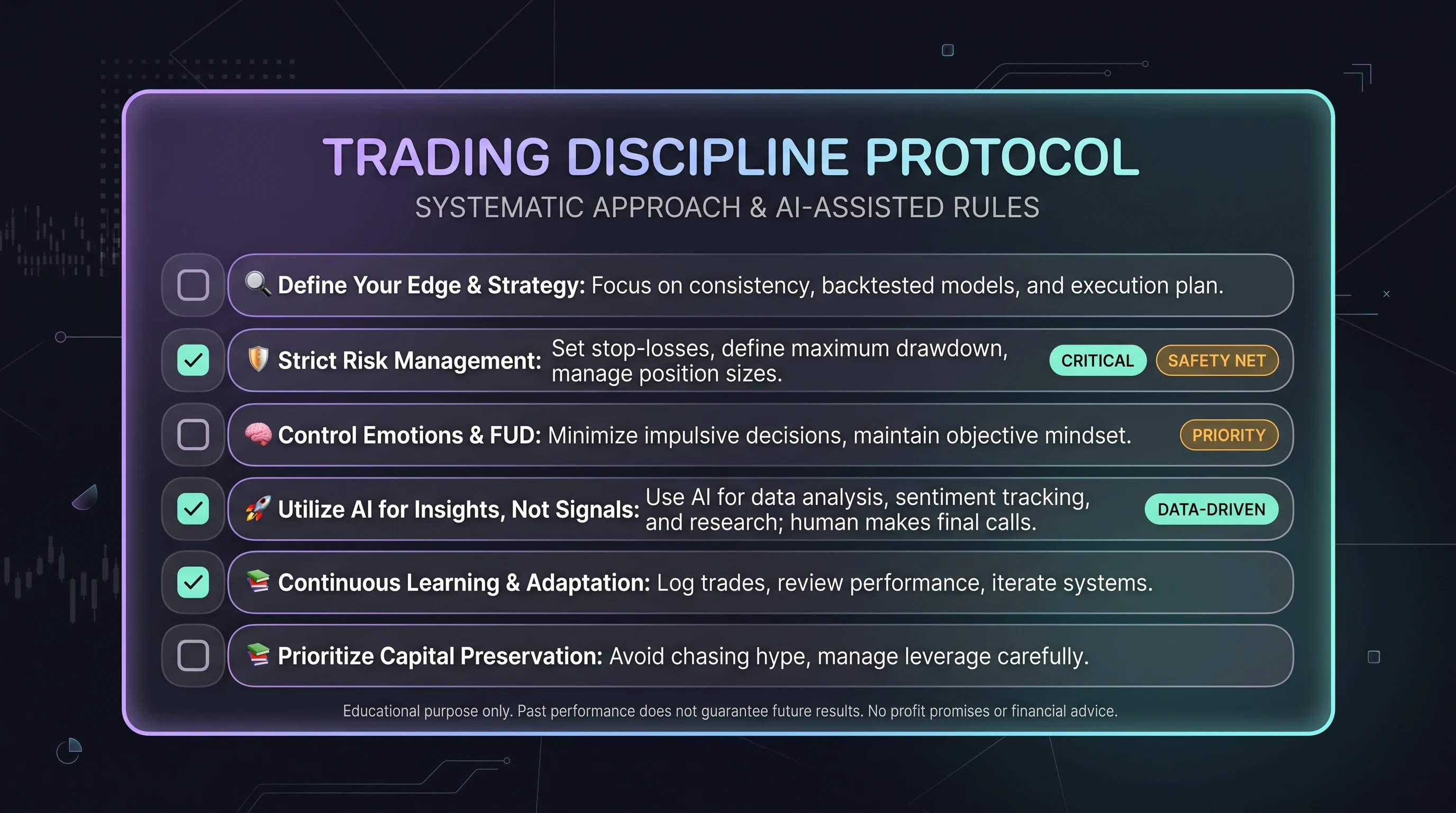
How to Create a Trading Rulebook You Actually Follow
A trading rulebook sounds simple until the market is moving quickly. Most traders do not break rules because they forgot how to write them. They break rules because the rules are vague, too complicated, or easy to reinterpret in the moment.
A useful trading rulebook should do one job: make the next decision easier before emotion gets involved.
For prop firm traders, that matters even more. A funded account or challenge is not only about finding setups. It is also about operating inside constraints such as daily loss limits, maximum drawdown, position sizing rules, holding restrictions, news rules, and payout requirements. A rulebook helps turn those constraints into a repeatable process.
The goal is not to create a perfect document. The goal is to create a short, practical system you can check before, during, and after each trading session. This rulebook is one piece of the broader system covered in Trading Discipline for Prop Firm Traders: A Practical System.
Why most trading rulebooks fail
Many trading rulebooks fail for one of four reasons.
First, they are too broad. A rule like “be disciplined” sounds good, but it does not tell you what to do when you are down for the day and another setup appears. A useful rule needs a clear action.
Second, they are too long. If your rulebook is fifteen pages, you probably will not review it before a session. The more complicated the document becomes, the easier it is to ignore.
Third, they are written after the fact. If a trader writes rules only after a painful loss, the document may become emotional instead of operational. Rules should be reviewed calmly, not only during frustration.
Fourth, they are not measured. A rule that is never checked becomes a preference. A rulebook needs a review process, otherwise there is no accountability loop.
Start with non-negotiable risk rules
A trading rulebook should begin with risk because risk rules define when you are allowed to continue trading and when you must stop.
For a prop firm trader, these rules should be aligned with the firm’s actual requirements. That may include daily drawdown, maximum drawdown, maximum lots, prohibited trading windows, minimum trading days, or consistency rules.
Examples of risk-rule categories include:
- Maximum risk per trade
- Maximum number of trades per day
- Maximum daily loss before stopping
- Maximum weekly loss before reducing activity
- Rules for trading near drawdown limits
- Position-size calculation method
- Stop-loss placement rule
- Conditions that automatically disqualify a trade
The exact numbers depend on the trader, strategy, account size, and firm rules. This article does not recommend specific risk settings. The important point is that the rulebook should define the limit before the session starts.
CFTC and FINRA risk disclosures repeatedly warn that leveraged and day-trading activity can lead to large losses, and that traders should be cautious of claims that imply easy or guaranteed returns. A rulebook should reflect that reality by focusing on risk control, process, and review rather than confidence or predictions.
Make every rule observable
A rule is easier to follow when it can be checked quickly.
Weak rule: “Do not overtrade.”
Observable rule: “Stop trading after three completed trades or after reaching the daily loss limit, whichever comes first.”
Weak rule: “Only take good setups.”
Observable rule: “A trade is valid only if it matches one of the named setups in my plan, includes a planned stop before entry, and is taken during an approved session.”
Weak rule: “Stay calm.”
Observable rule: “If I tag two trades in a row as frustrated, rushed, or revenge, I stop trading and write a two-minute review note before the next session.”
Observable rules reduce negotiation. They also make journaling more useful because each trade can be marked as compliant or non-compliant.
Use a one-page rulebook structure
The best rulebook is usually short enough to review daily. A practical structure is one page with five sections.
1. Market and session rules
Define when and where the strategy is allowed to operate.
Questions to answer:
- Which pairs, markets, or instruments are allowed?
- Which sessions are allowed?
- Are there restricted times around news or volatility events?
- What conditions make the market unsuitable?
The point is not to predict the market. The point is to define the environment where the plan is allowed to operate.
2. Setup rules
List the setup names you are allowed to trade. Each setup should have minimum criteria.
For example:
- Setup name
- Required market context
- Entry trigger
- Stop placement logic
- Exit or management logic
- What invalidates the setup
If a trade does not match a named setup, it should be tagged as outside plan. That does not mean the trader is bad. It simply creates honest data for review.
3. Risk rules
Write the risk rules clearly. This is where prop firm constraints should appear.
Include:
- Maximum risk per trade
- Daily stop rule
- Maximum number of trades
- Position-size process
- Drawdown buffer rule
- Rule for reducing size or stopping after repeated losses
If a funded account has specific restrictions, those restrictions should be copied into the trader’s own rulebook in plain language.
4. Behavior rules
Behavior rules define what to do when emotions change the quality of decisions.
Examples:
- No immediate re-entry after a losing trade unless the setup reappears and passes the checklist.
- No trading after a rule break until the trade is journaled.
- No adding risk to recover a loss.
- Take a fixed pause after two consecutive losses.
- Stop after a major rule violation and review it outside market hours.
These rules are not about willpower. They are about creating a circuit breaker before one mistake becomes a sequence.
5. Review rules
A rulebook is incomplete without a review process.
Define:
- When trades must be journaled
- Which tags must be used
- How often weekly review happens
- What metrics matter for review
- How rule changes are tested
A simple weekly review can ask:
- How many trades followed the rulebook?
- Which rules were broken most often?
- Did rule-following trades behave differently from rule-breaking trades?
- Which time of day or emotional tag appeared before mistakes?
- What one rule or habit should be focused on next week?
The final question matters. A rulebook becomes easier to follow when improvement is focused on one behavior at a time.
Add a pre-trade checklist
The rulebook is the full operating system. The checklist is the quick version used before a trade.
A simple checklist might include:
- Is this setup in my written plan?
- Is the trade during an approved session?
- Is my stop planned before entry?
- Is position size calculated before entry?
- Am I within daily and account-level risk limits?
- Am I taking this trade for a setup reason, not to recover a loss?
- Is there any rule that disqualifies the trade?
If the answer to any required question is no, the trade is not valid under the rulebook.
This does not mean the next valid trade will win. It only means the trader followed the process they chose in advance.
Score compliance instead of relying on memory
A trading journal should help measure whether the rulebook is being followed. One simple method is a rule-compliance score.
For each trade, mark:
- Setup rule followed: yes or no
- Risk rule followed: yes or no
- Entry rule followed: yes or no
- Stop rule followed: yes or no
- Behavior rule followed: yes or no
That creates a simple five-part score. Over time, the trader can review whether mistakes cluster around one rule category.
For example, a trader may discover that setup selection is strong but behavior rules break after the first loss of the day. Another trader may find that most problems come from position size or trading outside the approved session.
This is the real value of a rulebook: it turns vague discipline problems into reviewable data.
Version your rulebook carefully
A rulebook should evolve, but not every emotional reaction deserves a new rule. If the rules change after every losing day, the trader never gets enough data to know whether the process is working.
Use a simple versioning process:
- Keep the current rulebook active for a defined review period.
- Track compliance and notes during that period.
- Identify one recurring issue.
- Change one rule at a time.
- Write why the change was made.
- Review whether the change improved process consistency.
This helps prevent random edits. The rulebook becomes a living document, not an emotional reset button.
How PropLog AI can support rulebook discipline
PropLog AI can help traders organize the rulebook workflow by connecting rules to journal entries, tags, P&L calendar views, and weekly reviews. Instead of keeping rules in one place and trade notes somewhere else, a trader can review whether real trades matched the written process.
Useful PropLog AI workflows may include:
- Tagging trades by setup name
- Marking rule-compliant and non-compliant trades
- Reviewing mistakes by day, session, or emotional tag
- Connecting rule breaks to P&L calendar patterns
- Using Propol AI Coach for educational reflection on journaled behavior
PropLog AI does not provide buy or sell signals, financial advice, investment advice, or guaranteed outcomes. Its role is to help traders organize their own data and reflect on their own process.
A starter trading rulebook template
Use this as a simple first version.
My allowed markets and sessions
- Markets or pairs:
- Sessions:
- Restricted times:
- Conditions when I do not trade:
My valid setups
- Setup 1:
- Setup 2:
- Setup 3:
- What invalidates a setup:
My risk rules
- Maximum risk per trade:
- Daily stop rule:
- Maximum trades per day:
- Drawdown buffer rule:
- Position-size method:
My behavior rules
- After a losing trade, I will:
- After two consecutive losses, I will:
- If I feel rushed or frustrated, I will:
- If I break a rule, I will:
My review rules
- I journal each trade by:
- I complete weekly review on:
- My main compliance score is:
- My focus rule for next week is:
Final thought
A trading rulebook is not a prediction tool. It does not remove risk, guarantee consistency, or ensure trading results. Its value is simpler: it helps the trader decide in advance what behavior is acceptable and then review whether that behavior happened.
For prop firm traders, that can make the difference between a vague discipline goal and a measurable process. Start with one page, make every rule observable, track compliance honestly, and improve one rule at a time.
Start your trading journal
Track trades, understand your psychology, and get personalized AI coaching. No signals, no financial advice — just better self-review from your own data.
Get Started Free