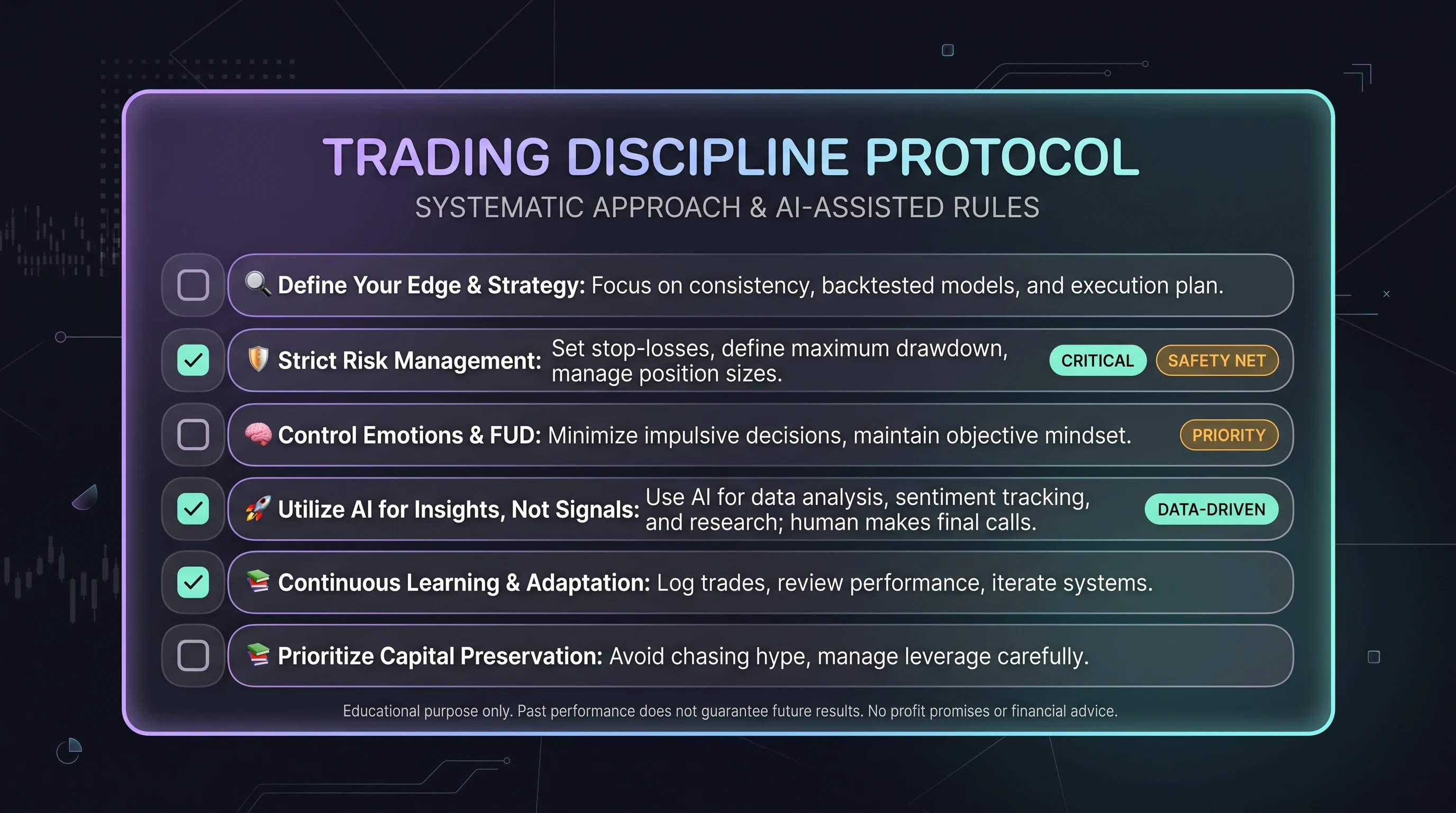
Trading Discipline
Trading Discipline for Prop Firm Traders: A Practical System
Build a practical trading discipline system for prop firm rules, daily routines, risk review, journaling, and process accountability without relying on motivation.
Trading Discipline for Prop Firm Traders: A Practical System
Trading discipline is often described as willpower, but willpower is not a reliable operating system. Prop firm traders need something more practical: a repeatable structure for planning, executing, reviewing, and correcting behavior while staying inside account rules.
What trading discipline really means
Trading discipline is the ability to follow a defined process before, during, and after a trade. It is not the same as never feeling fear, frustration, impatience, or excitement. Those emotions still appear. Discipline means the trader has a system that reduces the chance that those emotions control the next decision. Why those emotions surface in the first place is its own subject — trading psychology for prop firm traders — while this article focuses on the behavioral system that holds up regardless of what is happening internally.
For prop firm traders, discipline usually includes:
- Respecting daily loss and maximum drawdown rules
- Sizing positions according to a prewritten plan
- Avoiding revenge trades after losses
- Avoiding oversized trades after wins
- Following a documented setup instead of improvising
- Reviewing behavior regularly instead of judging only profit and loss
The goal is not perfection. The goal is to create a feedback loop that makes rule breaks easier to notice and correct. Overtrading is one of the most common patterns that feedback loop is designed to catch.
Why prop firm discipline is different
A retail trader may review performance mostly through profit and loss. A prop firm trader has another layer: account constraints. A single undisciplined day can matter because the rules may be strict, specific, and time-sensitive.
That makes discipline more operational. A trader needs to know not only whether a trade was profitable, but also whether it fit the account parameters. For example:
- Was the planned risk written before entry?
- Was the trade still valid after spread, slippage, or session conditions?
- Was the trader close to a daily loss limit?
- Did the trader increase size after an emotional event?
- Did the trader keep trading after the original plan was finished?
These questions turn discipline into observable behavior. Observable behavior can be journaled, tagged, reviewed, and improved.
Step 1: Write a rulebook that is short enough to follow
Many trading rulebooks fail because they are too long. If a rulebook has dozens of vague rules, it becomes difficult to use in real time. A practical rulebook should focus on the few behaviors that matter most. For a closer walkthrough of building one, see how to create a trading rulebook you actually follow.
Start with five categories:
- Market conditions: when trading is allowed or avoided
- Setup requirements: what must be present before entry
- Risk limits: maximum risk per trade and per day
- Execution rules: entry, stop, target, and trade management standards
- Stop rules: when the trader must stop trading for the day
Each rule should be written in clear language. “Be patient” is not a rule. “No new trade for 15 minutes after closing a losing trade” is a rule. “Manage risk” is not a rule. “Every trade must have planned invalidation before entry” is a rule.
Step 2: Use a pre-trade checklist
A pre-trade checklist slows the decision down before the order is placed. It does not need to be complicated. The checklist exists to prevent avoidable mistakes.
A simple checklist might ask:
- What is the setup name?
- What condition invalidates the idea?
- What is the planned risk?
- Does this trade fit the account rules?
- Am I trading because of a plan or because of emotion?
- Have I already reached a stop rule today?
If the trader cannot answer these questions, the trade is not ready for execution. That does not mean the market idea is right or wrong. It simply means the process is incomplete.
Step 3: Define stop rules before the session starts
Stop rules are essential because many discipline failures happen after the trader is already emotionally activated. A stop rule decides in advance when the session should end or pause.
Examples of stop rules include:
- Stop trading after reaching a daily risk limit
- Pause after two consecutive losses
- Pause after a rule break, even if the trade was profitable
- Stop trading after a planned session window ends
- Stop trading when tired, distracted, or rushed
The important part is that the rule is decided before the emotional moment. A trader is less likely to make a clear decision after a frustrating loss or a surprising win.
Step 4: Track discipline separately from P&L
Profit and loss can be noisy over a small sample. Discipline tracking gives the trader another way to evaluate the quality of the process.
A trading journal can include fields such as:
- Rule followed: yes, partial, or no
- Setup followed: yes, partial, or no
- Planned risk followed: yes, partial, or no
- Emotional state: calm, rushed, frustrated, overconfident, hesitant
- Stop rule respected: yes or no
- Lesson: one sentence
This helps separate outcome from behavior. A losing trade may still be a strong process trade. A profitable trade may still reveal a dangerous habit if it violated the trader’s rules.
Step 5: Review the week, not just the trade
Discipline patterns often become clearer at the weekly level. One trade may look random. A week of journal entries can reveal repeated triggers.
A weekly discipline review can ask:
- Which rule did I follow most consistently?
- Which rule did I break most often?
- What emotion appeared before my worst decisions?
- Did rule breaks cluster on specific days, sessions, or after certain outcomes?
- What is one behavior to focus on next week?
The review should produce one practical adjustment. Avoid choosing five improvements at once. A narrow focus is easier to measure.
Step 6: Build a recovery plan for rule breaks
A rule break does not have to become a spiral. The key is to decide what happens next before the next emotional decision appears.
A recovery plan might include:
- Log the rule break immediately
- Stop trading for a fixed cooling-off period
- Write one sentence about the trigger
- Review whether the account is near any risk limit
- Resume only if the original session plan still allows it
The purpose is not self-criticism. The purpose is interruption. A recovery plan breaks the chain between one mistake and the next mistake.
How PropLog AI can support a discipline system
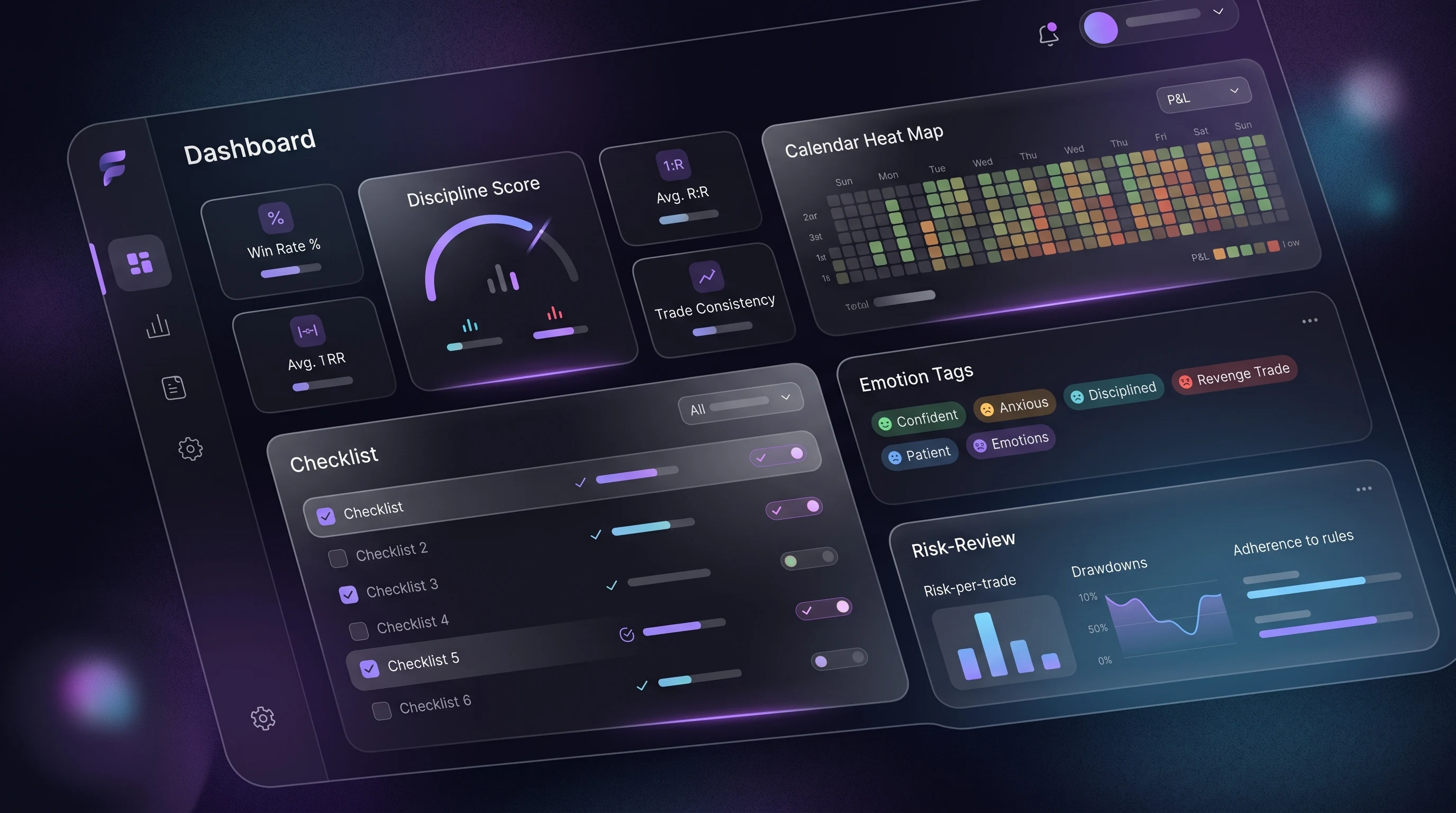
PropLog AI can help traders organize the parts of a discipline system: journal entries, tags, P&L calendar views, rulebook notes, daily routines, and AI-assisted reflection prompts.
For example, a trader could review:
- Which emotional tags appeared before rule breaks
- Which sessions had the strongest process adherence
- Whether losing days clustered after overtrading tags
- Which rule was missed most often during the month
- What weekly review notes repeated across several weeks
This is not trading advice and it is not a signal engine. The value is educational process review: helping the trader see their own behavior more clearly.
A practical discipline template
Use this template at the start and end of each trading day.
Before the session
- Today’s allowed session:
- Setups I am allowed to trade:
- Maximum planned risk:
- Stop rule for the day:
- One behavior to protect:
After each trade
- Setup name:
- Did I follow the setup?
- Did I follow planned risk?
- Emotional tag:
- One-sentence lesson:
End of day
- Best process decision:
- Worst process decision:
- Rule followed well:
- Rule to improve:
- Should I change the plan, or just follow it better?
Common mistakes to avoid
Depending on motivation
Motivation changes. A system should still work on days when the trader feels impatient, tired, or frustrated.
Tracking too many rules
A rulebook that is too large becomes hard to follow. Start with the rules that protect risk, process, and account constraints.
Ignoring profitable rule breaks
A profitable rule break is still important data. If the behavior is repeated, the trader may eventually face a much different outcome.
Reviewing only after bad days
Discipline review is most useful when it is consistent. Good days can contain weak process. Bad days can contain strong process.
Conclusion
Trading discipline for prop firm traders is not a personality trait. It is a system. The system includes a short rulebook, a pre-trade checklist, stop rules, journal tags, weekly reviews, and a recovery plan for mistakes.
The purpose is not to guarantee results. The purpose is to make behavior visible, measurable, and easier to review. For traders working under prop firm constraints, that kind of structure can support accountability, risk awareness, and a more consistent review process.
Start your trading journal
Track trades, understand your psychology, and get personalized AI coaching. No signals, no financial advice — just better self-review from your own data.
Get Started Free