Trading Journaling
Why Every Trader Needs a Trading Journal (And How to Actually Use One)
Most traders know they should journal. Few actually do it consistently. Here's why a trading journal is your single biggest edge — and how to make it stick.
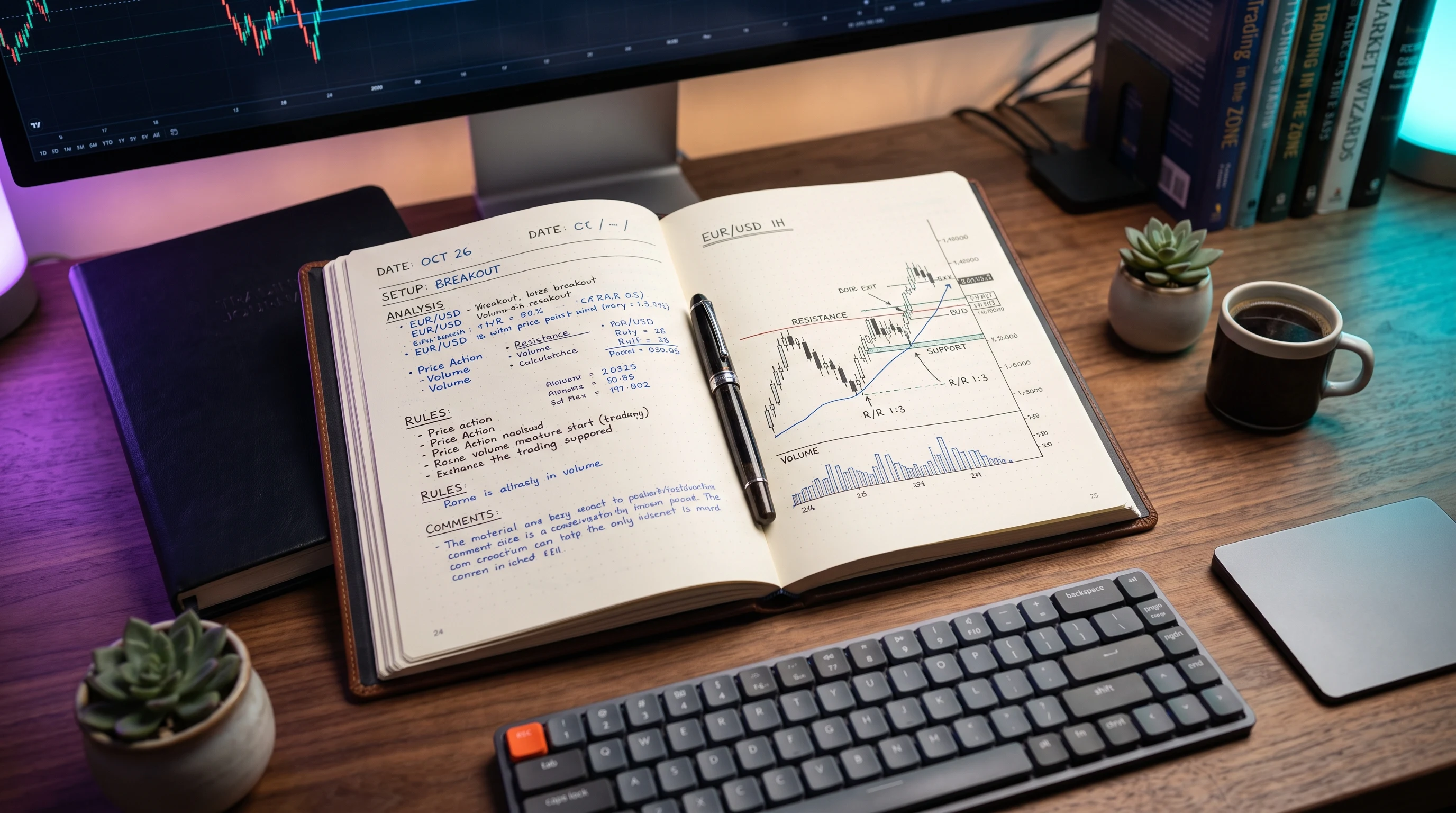
You’ve probably heard it a hundred times: “Keep a trading journal.”
And you’ve probably tried it. Maybe a spreadsheet. Maybe a notes app. Maybe you kept it up for a week before it felt like homework and you stopped.
You’re not alone. Most traders abandon their journal within the first month. But the traders who stick with it? They’re the ones who actually make it.
Here’s why — and how to make journaling work for you without it feeling like a chore.
The Real Reason Journaling Works
It’s not about record-keeping. You can pull your trade history from your broker any time.
Journaling works because it forces you to slow down and think about what you did and why.
When you log a trade, you’re not just recording numbers. You’re capturing:
- Your mindset — Were you calm, anxious, excited, bored?
- Your reasoning — Did you follow your setup or wing it?
- Your execution — Did you honor your stop loss? Did you take profit too early?
- Your lessons — What would you do differently next time?
This is the data no broker gives you. And it’s the data that actually moves the needle.
What Most Journals Get Wrong
The classic trading journal is a spreadsheet with columns for entry, exit, P&L, and maybe a notes field. The problem? It captures what happened but not why it happened.
A spreadsheet won’t tell you that you tend to revenge-trade after two consecutive losses. It won’t surface that your win rate drops 40% when you trade out of boredom. It won’t show you that your best trades happen on Tuesday mornings during the London session.
Your journal needs to capture context, not just data.
That means emotions, confidence levels, setup adherence, session timing, and the story behind each trade. The richer the context, the more powerful the patterns you’ll uncover. If you trade prop firm challenges or funded accounts, the next step is learning what prop firm traders should track in a journal.
The Three-Minute Journal Method
Nobody has time to write an essay after every trade. Here’s what actually works:
After each trade, spend three minutes answering:
- What was my setup? (Name it. If you can’t name it, that’s a red flag.)
- Did I follow it? (Yes, partially, or no — be honest.)
- How did I feel? (Pick 1-2 emotions. Not “fine” — real emotions.)
- What’s one thing I’d do differently? (One sentence max.)
That’s it. Three minutes. Do this consistently and you’ll have a goldmine of self-awareness data within a month.
From Journal to Improvement
Having a journal is step one. Reading it back is where the magic happens.
Set a weekly ritual — Sunday evening, 15 minutes. Read through your week’s entries and look for patterns:
- Which emotions show up before your losing trades?
- Which setups have the highest win rate?
- When do you break your rules, and what triggers it?
- What’s the one mistake you keep repeating?
This weekly review is where most traders have their “aha” moments. The patterns are usually obvious once you see them written down — you just couldn’t see them in the heat of the moment.
Let AI Do the Pattern-Finding
Reading your own journal works, but you’ll inevitably have blind spots. You might not notice that your FOMO trades have a 23% win rate, or that you perform significantly better in the Asian session.
This is where AI-powered journaling shines. Tools like PropLogAI analyze your journal entries — emotions, setups, timing, discipline — and surface patterns you’d miss on your own.
Not trading advice. Not signals. Just a mirror held up to your own behavior, backed by your own data.
Start Today, Not Monday
The best time to start journaling was when you placed your first trade. The second-best time is right now.
Don’t wait for the “perfect” system. Don’t build an elaborate spreadsheet. Just start capturing three things after every trade: what you did, how you felt, and what you’d change.
Consistency beats perfection. A messy journal you actually use is infinitely more valuable than a beautiful spreadsheet you abandon after a week.
Your future self will thank you.
Start your trading journal
Track trades, understand your psychology, and get personalized AI coaching. No signals, no financial advice — just better self-review from your own data.
Get Started Free