Trading Journaling
P&L Calendar for Traders: Spot Revenge Days and Losing Streaks
Learn how traders can use a P&L calendar to review losing streaks, spot revenge-trading patterns, and build safer post-loss routines without relying on signals.
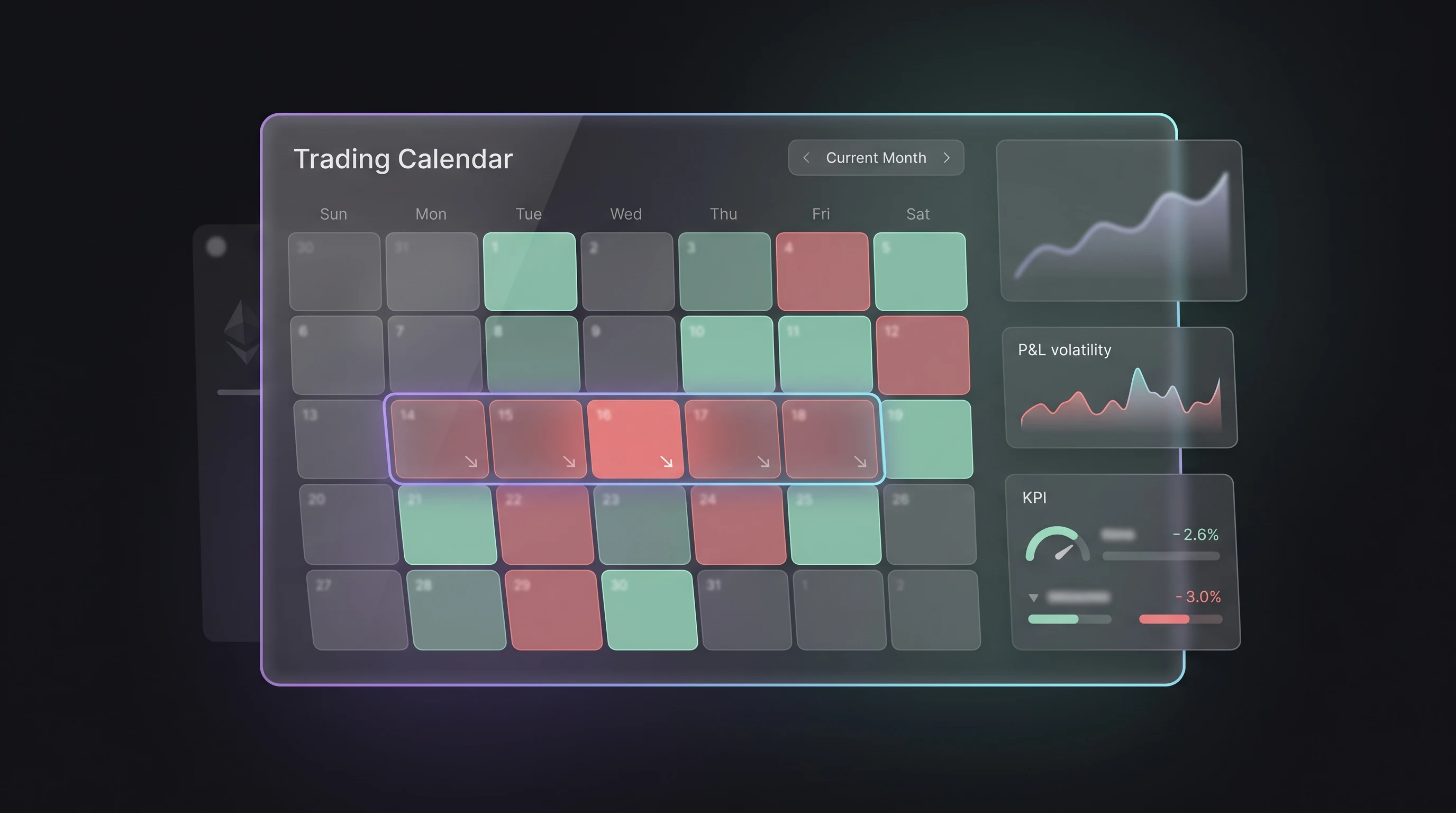
P&L Calendar for Traders: How to Spot Revenge Days and Losing Streaks
A P&L calendar can look simple: green days, red days, totals, and maybe a monthly summary. But for traders who review it carefully, the calendar becomes more than a scoreboard. It can show when losses cluster, when decision quality changes, and when a normal losing trade turns into a behavior problem. If you have not built a trading journal yet, how to keep a forex trading journal for funded accounts is a good place to start before layering in calendar-level review.
What a P&L calendar actually shows
A P&L calendar organizes trading results by day, week, and month. At the basic level, it answers questions such as:
- Which days were profitable, flat, or losing days?
- How large were the gains or losses compared with a trader’s normal range?
- Did losses cluster around certain sessions, weekdays, or market conditions?
- Did one bad day create behavior that affected the next day?
The goal is not to predict what will happen next. The goal is to create a structured review habit. A calendar view helps traders see sequences that are hard to notice when each trade is reviewed in isolation.
Why revenge days often stand out on a calendar
Revenge trading is not always obvious in the moment. It can feel like trying to recover, prove the plan still works, or avoid ending the day in red. On a P&L calendar, however, revenge days often leave a recognizable footprint.
Common signs include:
- A normal small loss early in the day followed by a much larger daily loss
- More trades than usual after the first losing trade
- Larger position size after a loss
- Lower-quality setups later in the session
- A day that moves from controlled loss to emotional decision-making
A single red day is not automatically a discipline problem. Losing trades are part of trading. The useful question is whether the day stayed within the trader’s plan, risk rules, and process.
How losing streaks look different from revenge trading
A losing streak and revenge trading are not the same thing.
A losing streak can happen even when a trader follows a plan. It may simply reflect normal variance, changing market conditions, or a strategy going through a weaker period. Revenge trading is different because the trader’s behavior changes after the loss.
A calendar review should separate these two categories:
| Pattern | What it may mean | Review question |
|---|---|---|
| Several small planned losses | Normal strategy variance may be present | Did I follow the same setup and risk rules? |
| One loss followed by many impulsive trades | Revenge behavior may be present | What changed after the first loss? |
| Larger-than-normal loss after a winning streak | Overconfidence may be present | Did I increase size or loosen rules? |
| Losses clustered at one session time | Context may matter | Am I trading a session that fits my plan? |
| Red days after poor sleep or distraction | Lifestyle context may matter | What non-market factors affected execution? |
This distinction matters because the response should be different. A planned losing streak may call for patient review. Revenge trading may call for the kind of stronger rules, cooldowns, and stop-trading protocols covered in Trading Discipline for Prop Firm Traders: A Practical System.
What to track on each calendar day
A useful P&L calendar should include more than the final number. Add enough context — similar to the journal fields tracked on individual trades — to understand the day without turning the review into a diary.
Daily result
Track profit or loss, but also normalize it. Some traders use R-multiple, percentage risk, or a planned daily risk unit so that results can be compared across account sizes.
Number of trades
Trade count is one of the clearest signals of overtrading. If a normal day has two or three trades and a losing day has nine, the calendar should make that obvious.
Rule adherence
Mark whether the day followed the trading plan. A red day with full rule adherence is different from a red day caused by ignored stops, oversized trades, or unplanned entries.
Emotional tags
Use short tags such as calm, rushed, frustrated, bored, FOMO, revenge, hesitant, or overconfident. Tags make patterns searchable during weekly review.
Session and context
Track the session, major news context if relevant, sleep quality, or distraction level. The point is not to blame outside factors, but to notice conditions that affect execution.
A practical review process for the end of each week
A P&L calendar becomes useful when it is reviewed on a schedule. A simple weekly review can take 15 to 20 minutes.
Use this sequence:
- Identify the largest red day.
- Identify the first trade or decision that changed the tone of that day.
- Check whether trade count increased after the first loss.
- Review whether position size stayed inside the plan.
- Note the emotional tags that appeared before poor decisions.
- Choose one rule to protect next week.
The last step is important. A review should produce one practical behavior change, not a long list of vague promises.
Example: spotting a revenge day
Imagine a trader has a planned daily risk limit of 2R. On Tuesday, the first trade loses 0.5R. That loss is normal. The next trade is also planned and loses 0.5R. At this point, the trader is down 1R but still inside the plan.
Then the behavior changes:
- The trader enters three more trades without waiting for the usual setup.
- Position size increases to recover the morning loss.
- Notes mention frustration and urgency.
- The day ends at -3.5R.
The calendar should not simply label Tuesday as a losing day. It should label Tuesday as a process-break day. The useful lesson is not “avoid losses.” The useful lesson is “after two planned losses, stop trading or take a structured cooldown.”
How to build a post-loss rule from calendar data
Once a trader sees the same pattern several times, the next step is a protective rule. The rule should be specific enough to follow under stress.
Examples include:
- After two losing trades, take a 30-minute break before any new entry.
- After reaching a preset daily loss amount, stop trading for the day.
- If trade count reaches the planned daily maximum, no more entries are allowed.
- If the journal tag is revenge or rushed, the next trade requires a written checklist.
- If a losing streak reaches a defined threshold, reduce review scope and avoid changing the full strategy until enough data is available.
These are process rules. They do not guarantee outcomes. Their purpose is to reduce impulsive decisions and make behavior easier to review.
How stress can affect trading decisions
Stress can change how people evaluate risk. Research published in PNAS found that sustained cortisol elevation shifted financial risk preferences and made risk perception more dynamic under uncertainty. For traders, the practical lesson is simple: decision quality after a loss may not feel the same as decision quality before the loss.
That is why a P&L calendar should not only record results. It should help the trader identify when stress, frustration, or urgency may have changed the process.
Where PropLog AI fits
PropLog AI can help traders organize P&L calendar data, trade tags, journal notes, weekly reviews, and AI-assisted reflection in one workflow. Instead of manually scanning scattered notes, a trader can review patterns such as red-day clusters, emotional tags, trade count changes, and rule adherence.
The value is educational and organizational. PropLog AI does not provide buy or sell signals, financial advice, investment advice, or guaranteed trading results. It helps traders ask clearer review questions based on their own journal data.
P&L calendar checklist
Use this checklist during weekly review:
- Which day had the largest loss?
- Was the loss caused by planned trades or process breaks?
- Did trade count increase after the first loss?
- Did position size change after frustration appeared?
- Which emotional tags appeared most often on red days?
- Were losses clustered around a specific session or weekday?
- Did any winning day create overconfidence the next day?
- What one rule should be protected next week?
Conclusion
A P&L calendar is not just a performance tracker. It is a behavior review tool. For traders, especially those operating under prop firm-style rules, the calendar can reveal when a normal loss becomes a revenge day, when losing streaks are being handled responsibly, and when risk discipline needs more protection.
The purpose is not to predict the market. The purpose is to build a clearer feedback loop: result, behavior, context, review, and one practical adjustment at a time.
Start your trading journal
Track trades, understand your psychology, and get personalized AI coaching. No signals, no financial advice — just better self-review from your own data.
Get Started Free