Trading Journaling
How to Keep a Forex Trading Journal for Funded Accounts
Learn how funded account traders can keep a practical forex trading journal that tracks rules, risk, emotions, and review notes without turning the process into busywork.
A funded account can make journaling feel more urgent than a normal demo or personal account. You are not only trying to understand your trading performance. You are also operating inside a rule set: daily loss limits, maximum drawdown, trading-day requirements, consistency rules, restricted strategies, payout conditions, and account review checkpoints.
That means a useful forex trading journal for funded accounts needs to do more than record entries and exits. It should help you answer three practical questions:
- Did I follow my own trading plan?
- Did I stay inside the funded account rules?
- What repeated behavior should I review before the next session?
The goal is not to create a beautiful spreadsheet that gets abandoned after a week. The goal is to build a simple review system you can actually maintain.
Why funded account traders need a different journal
Many traders start with a basic P&L log: pair, entry, exit, profit, loss, screenshot. That is useful, but it is incomplete for a funded account. A funded trader may technically be profitable while still creating risk around a drawdown rule, overtrading after a loss, or relying on one unusually good day that may not be repeatable.
Regulators such as the CFTC repeatedly warn that retail forex trading carries significant risk and that past performance does not guarantee future results. That warning matters for journaling because your journal should not be built around confidence, hype, or isolated winning trades. It should be built around evidence: what you did, whether it matched your plan, and what patterns keep repeating.
A funded account journal should therefore track both trading outcomes and process quality. In practice, that means logging the trade, the rule context, the risk context, and the behavior around the decision.
The minimum fields to track
Start with a compact journal. If your journal is too heavy, you will stop using it. The best first version is the one you can fill in quickly after every trade and review once a week.
Trade basics
Record the basic facts first:
- Date and session
- Currency pair or instrument
- Setup name
- Direction
- Entry price
- Exit price
- Planned stop
- Planned target
- Result in R-multiple
- Result in account currency
R-multiple is especially helpful because it normalizes trades by risk. A gain of $200 and a loss of $200 do not mean much unless you know how much was risked. A +2R trade means the trade returned two times the initial risk. A -1R trade means the planned risk was lost.
Funded account rule context
Next, record the rules that matter for the account:
- Daily loss limit remaining before the trade
- Maximum drawdown buffer before the trade
- Whether the trade was allowed under the firm’s rules
- Whether news, holding time, or lot-size restrictions applied
- Whether the trade affected a consistency requirement
This section should be factual, not emotional. You are creating a habit of checking the operating environment before and after each decision.
Process and behavior
Then record process quality:
- Was the setup in the written plan?
- Was the entry rule followed?
- Was the stop placed according to plan?
- Was position size calculated before entry?
- Was the trade taken during an approved session?
- Was there an emotion tag such as calm, rushed, frustrated, bored, or trying to recover?
A journal becomes more useful when it separates outcome from execution. A winning trade that broke the plan still deserves review. A losing trade that followed the plan may be acceptable if it fits the system’s expected distribution.
Use a simple discipline score
Funded account traders often focus on profit targets, but a trading discipline process score can be more useful during review. One simple method is to score each trade as either compliant or non-compliant with your written rules.
For example:
- 1 point if the setup matched the plan
- 1 point if the risk size matched the rulebook
- 1 point if the entry trigger was valid
- 1 point if the stop was respected
- 1 point if no revenge or impulse behavior was present
That creates a five-point process score for each trade. Over a week, you can calculate a discipline percentage. If you took 20 trades and 14 fully followed the rules, your rule-following rate was 70%.
This does not predict future results or guarantee better performance. It simply gives you a clearer way to review whether your behavior matched the system you claimed to be trading.
Review weekly, not just trade by trade
The weekly review is where the journal becomes useful. Daily logging captures raw material. Weekly review turns that material into decisions about process.
A practical weekly review can ask:
- What was my total result in R?
- What was my average R on rule-following trades?
- What was my average R on rule-breaking trades?
- Which setup appeared most often?
- Which time of day created the most mistakes?
- Did I come close to a funded account rule breach?
- What is the one behavior I should focus on next week?
The final question is important. Do not try to fix everything at once. If the journal shows that most mistakes came from trading after the daily plan was already complete, the next week’s focus might be: stop trading after two completed setups. If the pattern is oversized trades after a loss, the focus might be: reduce size automatically after a losing trade.
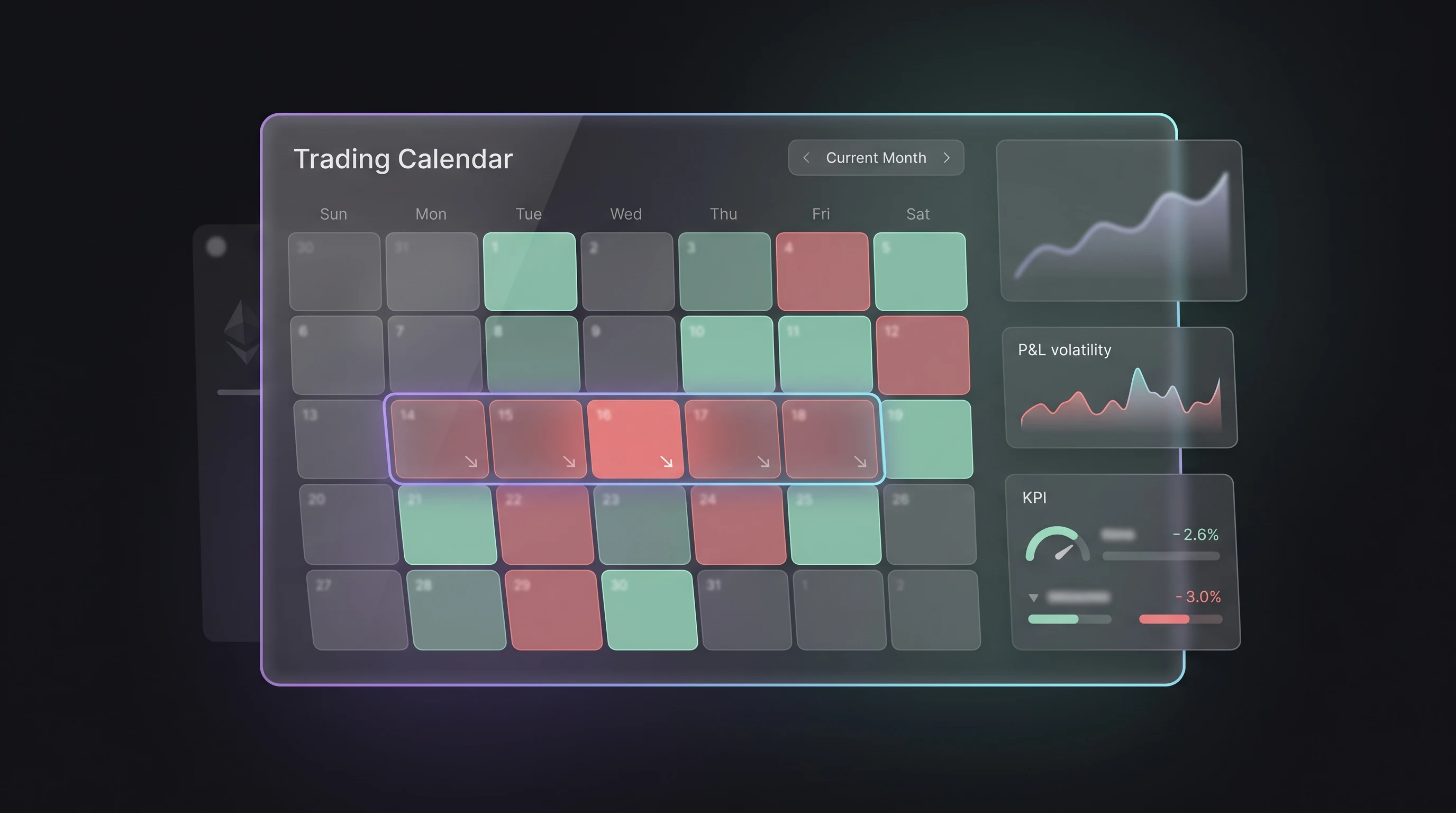
These are process experiments, not promises of profit. A P&L calendar can make these weekly patterns even easier to see at a glance.
Keep screenshots, but do not rely on them alone
Screenshots are useful because they preserve context. They can show the market structure, entry location, stop placement, and what the chart looked like before the outcome was known. But screenshots without structured tags are hard to review at scale.
A good approach is to combine both:
- Screenshot for visual context
- Setup tag for grouping
- Emotion tag for behavior review
- Rule-compliance score for discipline review
- R-multiple for risk-adjusted outcome
This makes the journal searchable. Instead of scrolling through dozens of images, you can filter for all trades tagged as “breakout,” “London session,” “frustrated,” or “rule break.”
What not to put in the journal
A trading journal should not become a diary with no structure. Long emotional notes can feel productive while making review harder. Instead of writing “I was angry and the market felt unfair,” use a tag such as “frustrated” and then add one short sentence about the trigger.
For example:
- Emotion: frustrated
- Note: Took second trade immediately after loss without waiting for normal trigger.
That is enough to review later.
Also avoid using the journal to justify trades after the fact. The key question is not “Can I explain why this trade made sense now?” The better question is “Did this trade match the plan before I entered?”
How PropLog AI can support the workflow
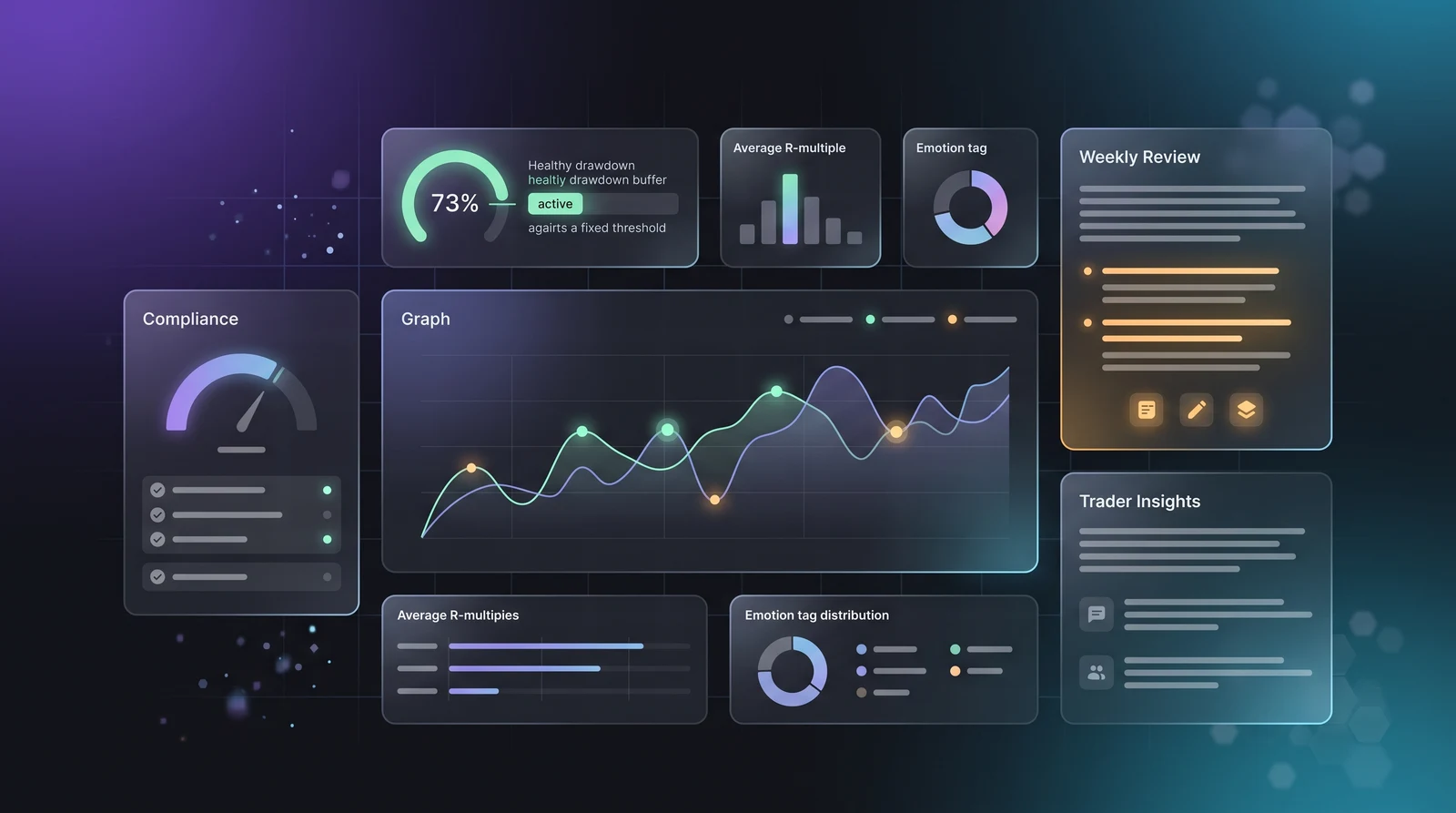
PropLog AI is designed around structured trading review rather than signal generation. For a funded account trader, that distinction matters. The product can help organize journal entries, trade tags, P&L calendar views, weekly reviews, and AI-assisted reflection based on the trader’s own records.
That means the journal can become easier to maintain and easier to review. Instead of manually searching through scattered notes, a trader can use structured fields to identify repeated mistakes, review discipline patterns, and prepare weekly summaries.
PropLog AI should not be treated as a source of buy or sell signals, financial advice, or guaranteed results. Its role is to help traders see their own behavior and process more clearly.
A starter template
Here is a simple funded account trading journal template:
- Date
- Session
- Pair
- Setup
- Direction
- Planned risk
- Result in R
- Result in account currency
- Daily loss buffer before trade
- Maximum drawdown buffer before trade
- Rule compliance score
- Emotion tag
- Screenshot link
- One-sentence lesson
For the weekly review, add:
- Total trades
- Total R
- Rule-following percentage
- Average R when rules were followed
- Average R when rules were broken
- Most common mistake
- One focus for next week
This is enough to begin. You can add fields later, but only after the habit is stable.
Final thought
A funded account journal is not about proving that you are a good trader. It is about creating an honest record of decisions under rules and pressure. The most useful journal is not the most complicated one. It is the one you keep consistently, review weekly, and use to make one clear process improvement at a time.
If you are trading a funded account or preparing for one, start with the simplest version today: record the trade, the rule context, the risk, the behavior, and the lesson. Over time, that evidence becomes the foundation for better self-review.
Start your trading journal
Track trades, understand your psychology, and get personalized AI coaching. No signals, no financial advice — just better self-review from your own data.
Get Started Free