Trading Psychology
Trading Psychology for Prop Firm Traders: Why Your Mind Breaks the Rules
Trading psychology is why prop firm traders break their own rules. Learn the patterns behind revenge trading, overconfidence, and FOMO, and how to spot yours.

Trading Psychology for Prop Firm Traders: Why Your Mind Breaks the Rules
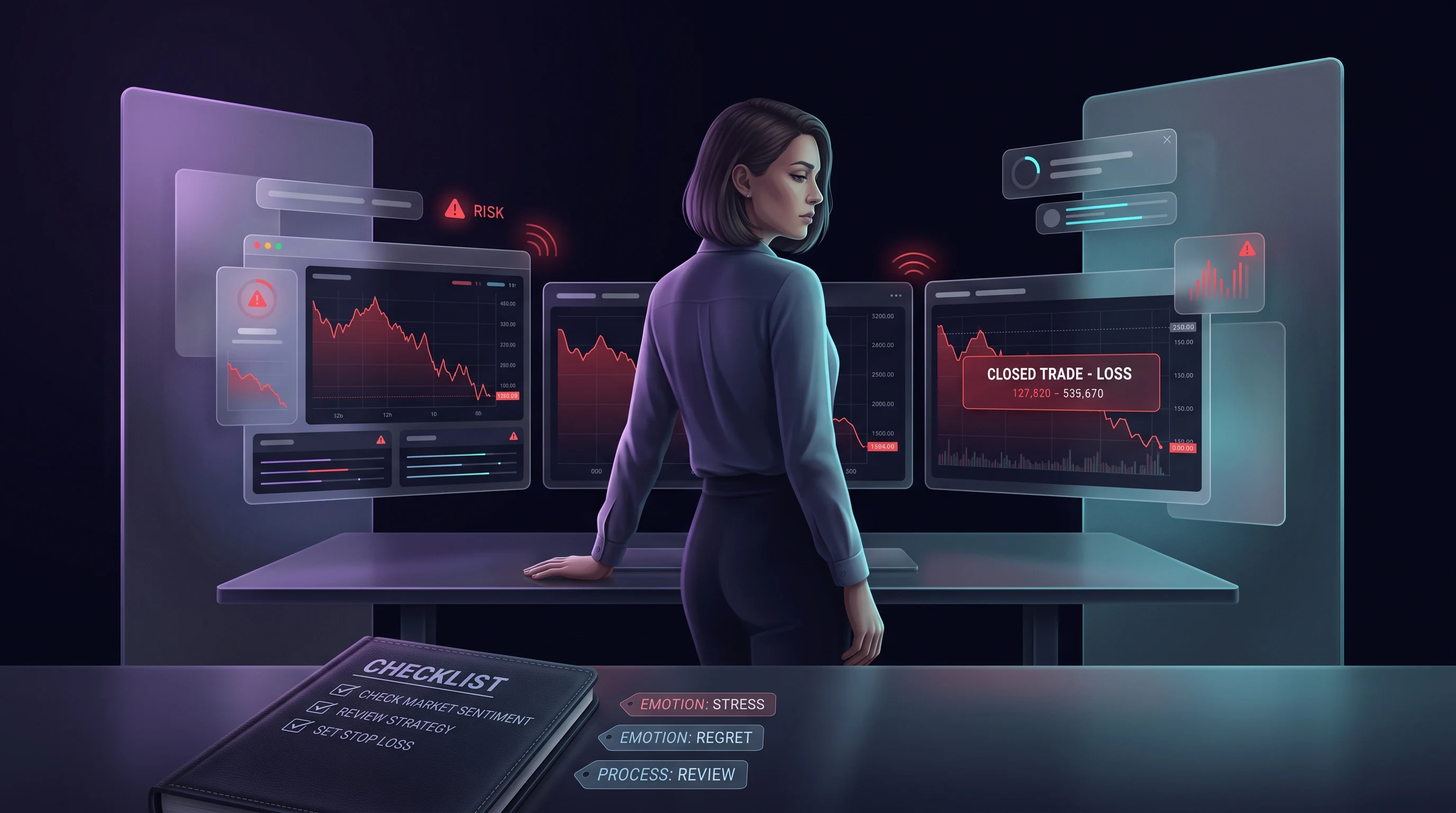
Most prop firm traders do not fail because they lack a strategy. They fail because, at some point during a session, they stop following the strategy they already had. The stop loss gets moved. The size gets doubled after a loss. A setup gets taken that was never on the plan. Ask most traders why, and the honest answer is usually “I don’t really know — it just happened.”
That gap between what a trader planned and what a trader actually did is trading psychology. It is not a personality flaw, and it is not something that gets fixed by “having more discipline” as a general resolution. It is a pattern, and patterns can be observed, tagged, and reviewed the same way a P&L number can.
Why prop firm accounts make psychology more visible
A personal trading account can absorb a bad emotional decision without much consequence beyond the loss itself. A prop firm account adds daily loss limits, maximum drawdown rules, consistency requirements, and a real deadline. That pressure does not create new psychological patterns — it exposes the ones that were already there.
A trader who tends to add size after two losing trades might get away with it on a personal account for months. On a funded account with a strict daily loss limit, the same pattern can end the account in a single session. This is one reason prop firm traders often describe psychology as “the real test,” even after they have already proven they can execute a strategy well enough to pass a challenge.
The patterns that most often break a trading plan
Reviewing journal data across many trades tends to surface the same handful of psychological patterns. None of these are unique or unusual — the value is in recognizing which ones show up in your own history, and how often.
Revenge trading. Re-entering immediately after a loss to “get it back,” often with a larger size and a weaker setup than the plan called for. This is one of the fastest ways a normal loss becomes an account-ending drawdown.
Overconfidence after a big win. A strong day can quietly change risk behavior on the next session — larger size, looser entry criteria, skipped checklist steps — because the last result felt like proof the plan does not need to be followed as closely.
Fear of missing out. Chasing an entry after a move has already happened, usually with a wider stop and lower conviction than a planned trade would have had.
Fear of losing. The opposite pattern — cutting winning trades early, avoiding valid setups, or sizing so small that a correct read barely matters. This one is easy to mistake for “being careful.”
Outcome bias. Judging a trade only by whether it made money, rather than whether it followed the plan. A rule-breaking trade that happens to win can quietly reinforce the exact behavior that will eventually cause a large loss.
Boredom trades. Taking a marginal setup during a slow session just to have a position on. Individually small, these trades tend to compound into a steady drag on results over a month.
Struggling after two losing trades. For many traders, execution quality does not decline gradually — it drops sharply after the second loss of the day, which is often the point where a plan quietly gets abandoned for the rest of the session.
Each of these deserves its own closer look. Trading Emotions: The Silent Account Killer walks through several of them in more detail, and Revenge Trading in Prop Firm Challenges: How to Stop the Cycle goes deeper on that specific pattern, with more articles on overconfidence and FOMO to follow. The starting point for all of them is the same: a pattern that has not been measured is a pattern that cannot be managed.
A quick self-check
Before building a full tracking process, it can help to check whether any of these show up in your own recent history:
- Have you moved a stop loss or target after a trade was already open, more than once this month?
- Has your position size changed noticeably right after a loss or right after a win, without a written rule telling you to change it?
- Do your notes ever say something close to “I don’t know why I took that one”?
- Have you kept trading after your plan for the day was already complete?
None of these individually mean much. A pattern across several weeks of tagged trades means considerably more than any single instance.
How to see your own patterns instead of guessing at them
Most traders already sense that “something” affects their decisions. Far fewer can say which emotion, on which sessions, correlates with which outcomes — because that requires structured data, not memory.
A useful starting process looks like this:
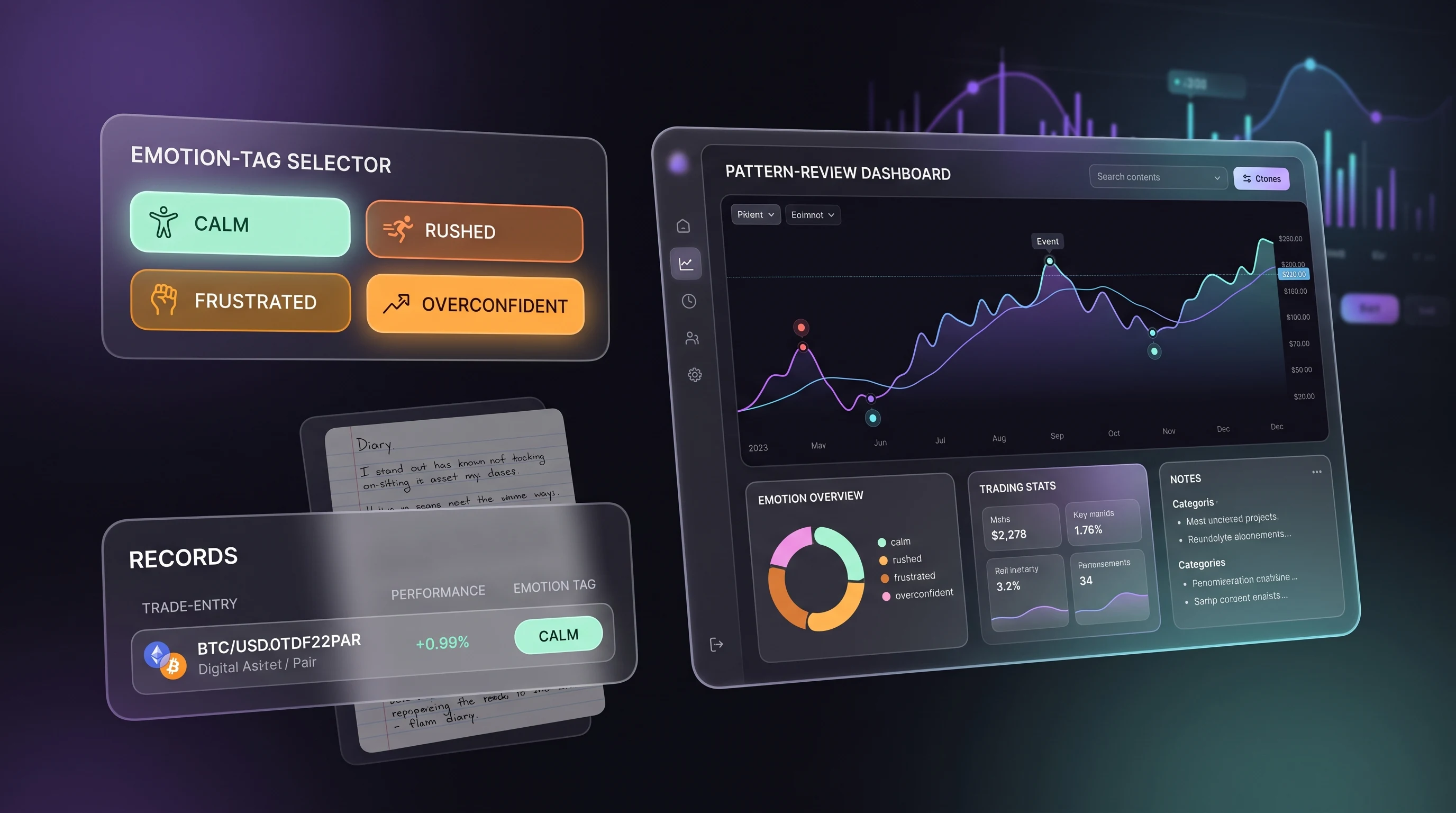
- Tag the emotion at the time of the trade, not after the outcome is known. Options like calm, rushed, frustrated, confident, and anxious are more useful than a single “good” or “bad” label — see how to track trading emotions without turning your journal into a diary for a structured way to do this.
- Record whether the trade matched the written plan, separately from whether it made money.
- Note what happened immediately before the trade — a loss, a win, a missed setup, or a long wait.
- Review weekly, looking specifically for repeated combinations: which emotion tag shows up before the largest losses, and which session or time of day tends to produce the most plan deviations.
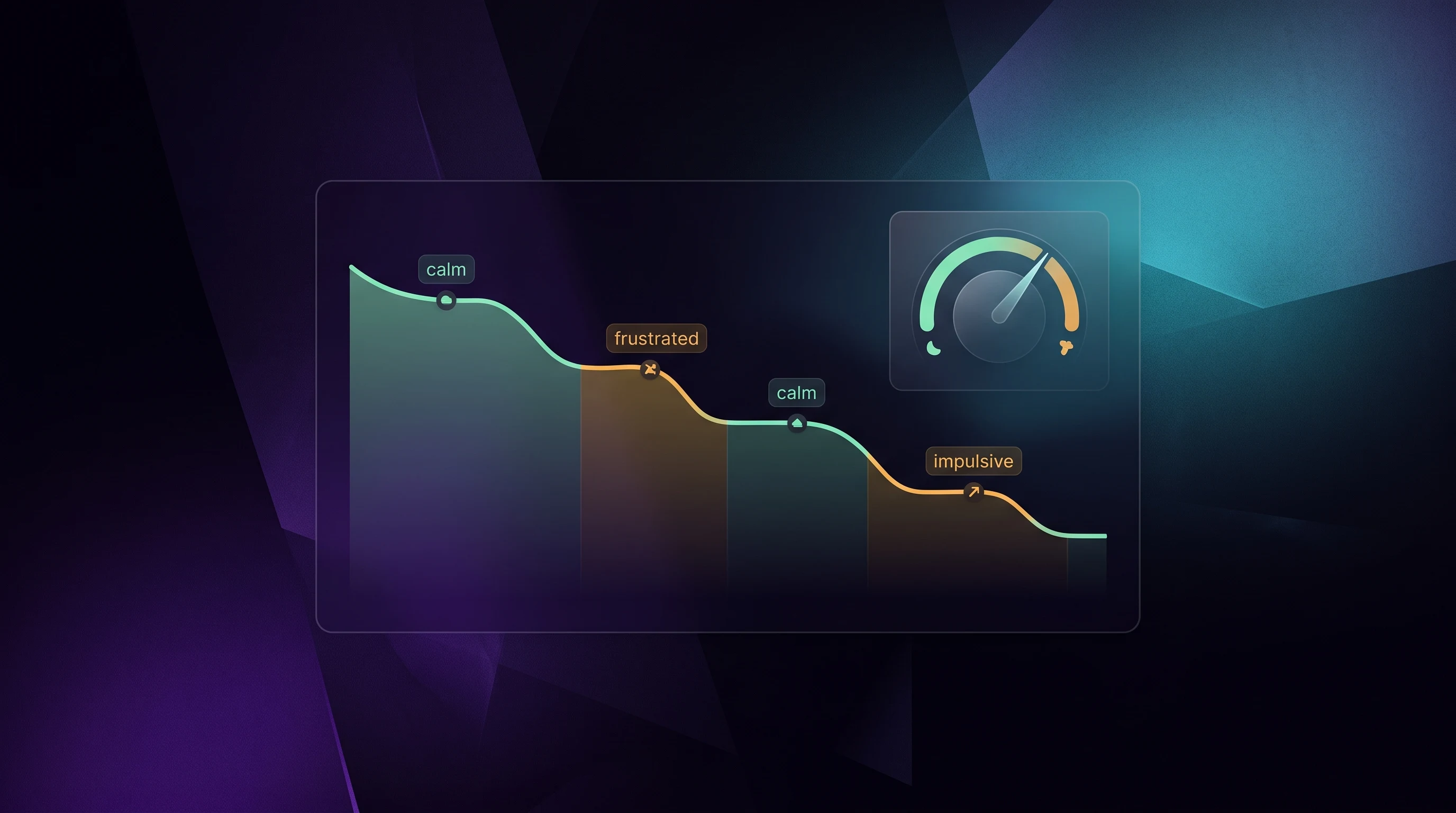
As an illustrative example of how this can look once a few weeks of tagged data exist: a trader might find that trades tagged “frustrated” carry a noticeably lower win rate than trades tagged “calm,” or that four of the five largest losses in a month all happened on the first trade after a losing streak. Numbers like these are specific to each trader’s own history — the point of tagging is to find your own version of that pattern, not to expect a universal one.
Turning awareness into a system, not a resolution
Recognizing a pattern is not the same as having a system to interrupt it. “I will stop revenge trading” rarely works as a standalone decision. A structural rule tends to hold up better: a fixed maximum number of trades per day regardless of outcome, a mandatory pause after two consecutive losses, or a rule that any trade taken outside the written setup list gets flagged for review rather than silently logged as a normal trade.
None of this requires predicting the market more accurately. It requires making the trader’s own behavior visible enough that a repeated mistake gets caught before it happens a tenth time instead of after.
How PropLog AI supports this without replacing your judgment
PropLog AI’s Propol AI Coach is built around this idea: your own journal, not a generic rulebook, is the most useful source of information about your trading behavior. Emotion tags, rule-compliance notes, and trade outcomes feed into pattern detection for things like revenge-trading sequences, tilt after consecutive losses, and overconfidence following a strong session — all surfaced from your own history rather than a one-size-fits-all list of trading rules.
Propol AI Coach does not predict markets, issue signals, or promise improved results. Its role is to make patterns in your own data easier to see and review, in the same way a monthly account statement makes spending patterns easier to see than a shoebox of receipts.
Where to go from here
Trading psychology is not a single problem to solve once. It is an ongoing review process: tag the behavior, track it against outcomes, and adjust one rule at a time based on what your own data actually shows — not on how confident you feel on any given day. Traders who improve fastest tend to be the ones who treat their own psychological patterns as data to investigate rather than a character flaw to feel bad about.
If you recognize one or two of the patterns above in your own trading, that is common, and it is also exactly the kind of thing a structured trading journal is built to catch. Combined with the practical discipline system covered in Trading Discipline for Prop Firm Traders: A Practical System and the field-level detail in Best Trading Journal for Prop Firm Traders, tracking the psychological side of every trade closes the loop between what you planned and what you actually did.
Start your trading journal
Track trades, understand your psychology, and get personalized AI coaching. No signals, no financial advice — just better self-review from your own data.
Get Started Free