Trading Psychology
How Emotions Affect Trading Decisions: A Practical Review
See how fear, frustration, FOMO, confidence, and boredom can change a forex trading decision—and how to review the change against your own plan.
You close an XAUUSD trade during the London session. The setup followed your plan, but the trade ends at −$42.
A few minutes later, you feel frustrated. Price starts moving again. You think, “I can take one more trade and make it back.”
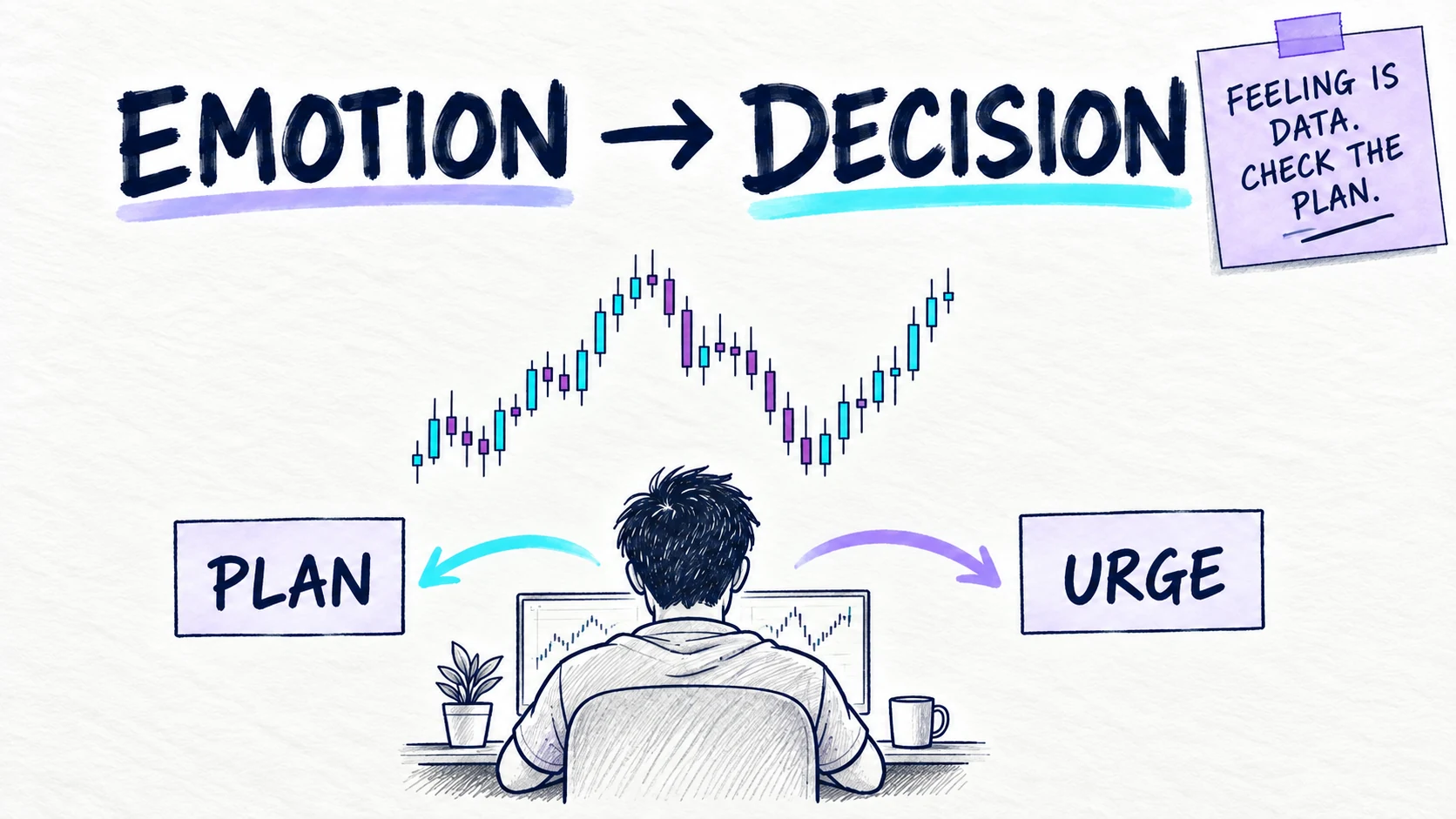
The feeling is not the mistake. The useful question is: did that feeling change your next decision?
Emotions can affect what you notice, how quickly you act, and whether you keep following the plan you wrote earlier. They do not automatically make a trade good or bad. You need to compare the decision with your own setup, confirmation, session, and sizing rules.
Quick answer: record the feeling, the urge it created, the decision you made, and what changed from your written plan. Review those four parts separately from profit or loss.
Start with the plan you wrote before the pressure
Your plan gives you something concrete to compare with the decision that followed.
Imagine your XAUUSD plan says:
- trade only during the London session;
- wait for a liquidity sweep of the Asian range;
- enter only after the breakout candle closes; and
- use the same sizing method recorded in your rulebook.
A liquidity sweep here means price briefly moves beyond a marked high or low before returning. A breakout close means the candle finishes beyond the level required by the trader’s own setup. These labels describe the fictional trader’s plan; they are not instructions to enter a trade.
A loss does not prove the decision was wrong
The fictional trade follows all four checks and still loses $42.
That result may feel uncomfortable, but it does not prove that the plan was broken. A planned trade can lose. An unplanned trade can also win.
If you judge only by the result, you may reward a rule break because it made money or blame a planned decision because it lost money. Keep the process and the outcome in separate fields.
Notice the urge before you judge it
After the loss, the trader sees movement as the New York session begins and wants one more trade.
The urge may feel like a clear opportunity. It may also be frustration, FOMO, or the wish to recover the earlier loss. You do not need to diagnose yourself. Give the feeling a simple name and check what it is asking you to change.
Ask factual questions:
- Is this the same named setup?
- Did the required confirmation happen?
- Is this inside the session written in the plan?
- Am I using the same recorded sizing method?
- Would I take this trade if the earlier result had been different?
The answers show whether the decision stayed with the plan. The emotion itself does not answer that question.
How common emotions may change a decision
The same feeling does not affect every trader in the same way. Use these as review prompts, not universal rules.
| Feeling you notice | Possible urge | Decision evidence to check |
|---|---|---|
| Fear | Exit early or avoid a planned setup | Did the exit or skip match a written rule? |
| Frustration | Enter again quickly after a loss | Was the next setup and confirmation actually present? |
| FOMO | Chase a move that already started | Did you enter at the planned point or after it? |
| Confidence | Loosen a filter or change size | Did the checklist or sizing method change after a win? |
| Boredom | Trade because the session feels quiet | Was there a named setup, or only a wish to be active? |
These are possible links between a feeling and a decision. They are not proof. Your journal needs to show what happened in your own trades.
The broader trading psychology guide explains how several behaviour patterns fit together. This article stays focused on the smaller moment when a feeling may change one decision.
Record feeling, urge, decision, and change
A short record is enough:
Instrument: XAUUSD
Session: New York
Earlier result: −$42
Feeling: Frustrated
Urge: Take one more trade immediately
Decision: Entered before the breakout candle closed
What changed: Confirmation rule was not followed
Result of the new trade: Record separately
Next review question: Does this happen after other losses?
Do not write “bad emotion” or “weak mindset.” Those labels do not tell you what changed. A useful record names an observable decision: entered early, changed size, stayed beyond the planned session, moved the stop, or accepted a different setup.
This is trading emotion tracking: recording a simple emotional state beside a specific trading decision so you can review whether the same combination appears again.
If you want the complete logging method, use the separate guide to tracking trading emotions before, during, and after a trade. That page owns the tag list and journal workflow. Here, the goal is only to understand the path from feeling to decision.
Review the complete sequence
The review sequence is:
- Plan: What setup, confirmation, session, and sizing method were written?
- Result: What happened on the trade?
- Feeling: What did you notice before the next decision?
- Urge: What did you want to do?
- Decision: What did you actually do?
- Change: Which written condition stayed the same or changed?
This sequence also helps you separate one emotional moment from a repeated pattern. One frustrated trade is one record. If the same feeling and the same plan change appear several times, you have something specific to review.
Do not use profit and loss as the emotion test
Suppose the second trade makes +$65 even though the trader entered before the required breakout close.
The profitable result does not repair the missing confirmation. The decision still changed from the written plan.
Now suppose the trader waits for the correct confirmation, takes the planned setup, and loses −$30. The loss does not prove the trader failed emotionally.
Use two separate questions:
- Process: Did the decision follow the written plan?
- Outcome: What profit or loss was recorded?
Keeping them separate protects the review from hindsight.
When frustration becomes revenge trading
Frustration after a loss is a feeling. Revenge trading describes a behaviour pattern where the next trade is taken mainly to recover the loss, often while the original process is being ignored.
Do not label every trade after a loss as revenge trading. Check the evidence. If the next trade had the same planned setup, confirmation, session, and sizing method, the order of results alone does not prove revenge.
If the session turns into repeated unplanned entries, the guide to overtrading in prop firm challenges shows how to compare activity with the written plan.
Where PropLogAI fits
PropLogAI lets you record emotions and whether a trade followed your own rules. Those tags can sit beside the instrument, session, setup, result, and review notes.
The record may help you notice combinations such as frustrated + entered early or confident + changed size in your own history. It does not diagnose your mental state, prove that an emotion caused a result, predict a trade, or tell you what to trade next.
You can use PropLogAI, a spreadsheet, or a notebook. The useful part is keeping the labels consistent enough to compare later.
Frequently asked questions
Should I try to remove emotion from trading?
No trader needs to become emotionless to complete a useful review. Notice the feeling and check whether the decision still matched the plan. The observable decision gives you something practical to compare.
Is fear always bad in trading?
No. Fear may be present while you still follow every written rule. It becomes relevant to the review when a decision changes, such as an early exit or skipped setup, and the change was not part of the plan.
Does a loss mean emotion affected the trade?
No. A planned trade can lose. Check the setup, confirmation, session, and sizing evidence separately from the result.
How should I record emotions without writing a diary?
Use one short tag, one short description of the urge, and one observable decision. The dedicated emotion-tracking guide explains the full structured workflow.
Can PropLogAI tell me which emotion caused a loss?
No. It can organize the tags and rule-adherence records you enter. A relationship in journal data does not prove that one feeling caused a particular result.
Sources and limits
Educational material from Zerodha Varsity and OANDA describes emotions as a normal part of trading decisions. PropLogAI uses that limited point only. The fictional XAUUSD examples and USD amounts in this guide are teaching records, not expected outcomes or universal behaviour patterns.
Your next useful question is not “Was I emotional?” It is “What changed in the decision?”
Start your trading journal
Track trades, understand your psychology, and get personalized AI coaching. No signals, no financial advice — just better self-review from your own data.
Get Started Free