Prop Firm Rules
Prop Firm Rules: What to Check Before You Buy a Challenge
Learn how to read prop firm rules, compare loss limits and restrictions, and build a one-page rule sheet before you buy a challenge.
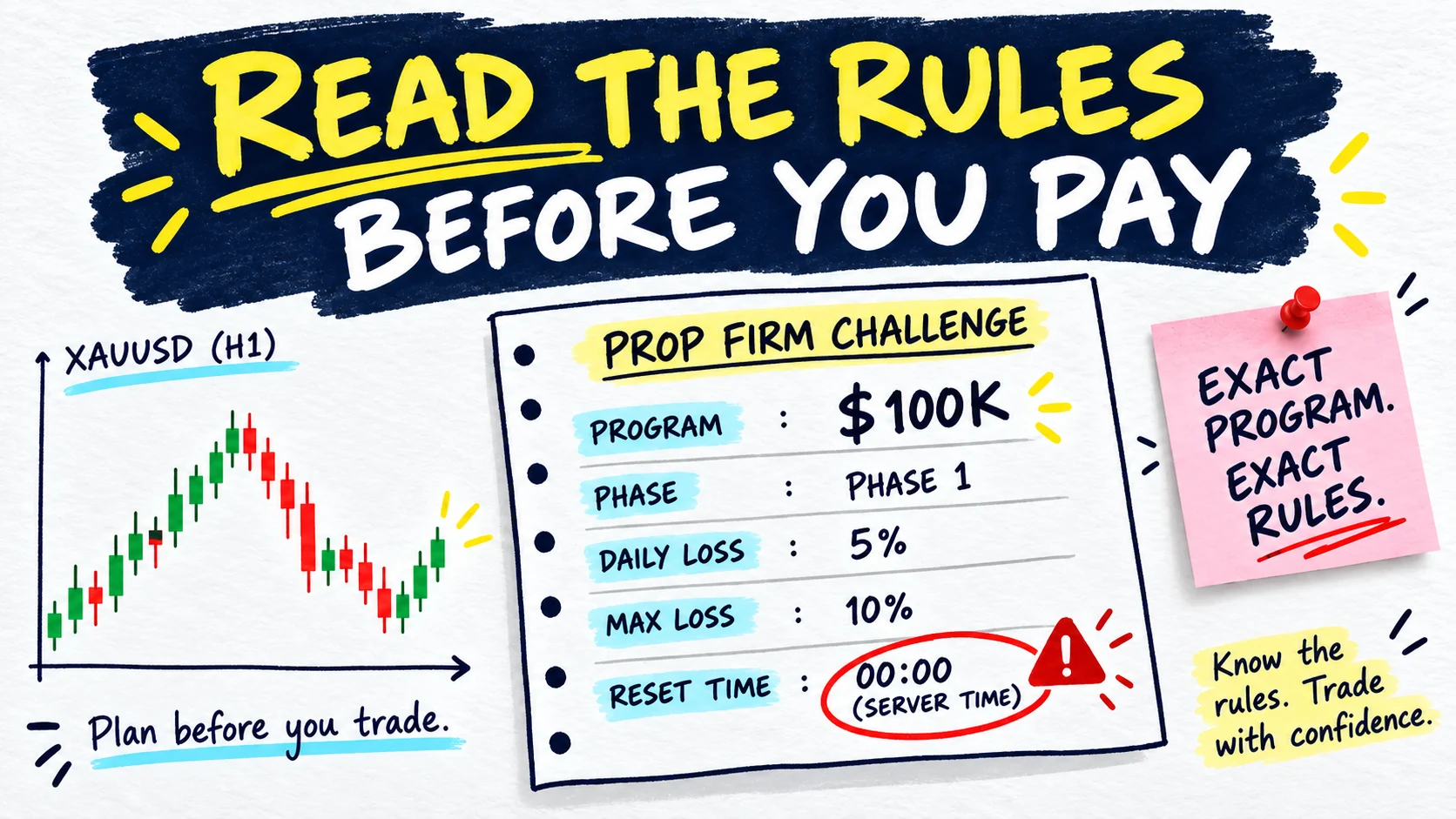
You are about to pay for a prop firm challenge. The account says $100,000 and the profit target looks possible. You feel ready to click Buy.
Pause for a few minutes.
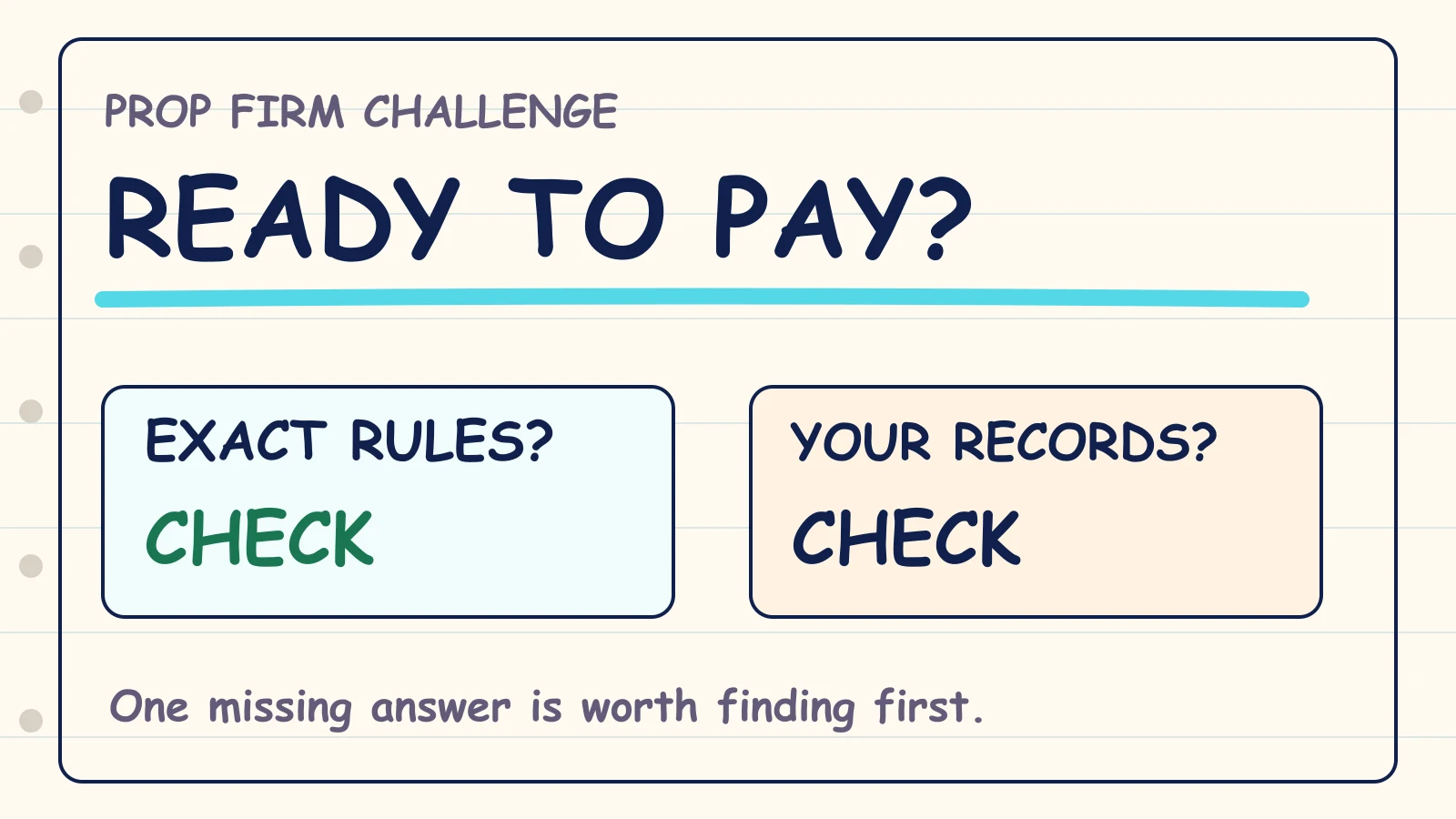
Those two numbers do not tell you how the account works. You still need to know how the firm calculates loss, when the day resets, which trades are restricted, and what happens if a condition is not met.
Quick answer: open the current official rules for the exact program and phase. Write every important rule in plain English, add one USD example, and record the consequence. Do this before you pay.
A prop firm challenge is an evaluation with rules set by the firm. This guide helps you read those rules. It does not recommend a firm or tell you that a challenge is suitable for you.
What should you check before buying a prop firm challenge?
Check four groups of information:
- Account identity: firm, program, phase, account size, platform, server time, and the date you checked the rules.
- Loss limits: daily loss, maximum loss, balance or equity basis, open profit or loss, fees, reset time, and whether the limit moves.
- Progress conditions: profit target, minimum trading days, time limit, consistency condition, and payout requirements.
- Trading restrictions: news, overnight or weekend holding, copy trading, prohibited methods, lot limits, and inactivity.
Do not combine rules from two programs. A firm may offer several challenges with different limits and different consequences.
Start with the exact program and phase
Write the full identity at the top of your rule sheet:
- firm name;
- exact program name;
- challenge phase or funded stage;
- account size;
- platform;
- server time zone;
- official rule-page link; and
- the date you checked it.
This date matters because firms can change their products or terms. If you return to the sheet later, you will know whether the rule needs another check.
The program name is not a small detail. On 2 October 2026, FTMO’s official objectives showed different loss methods for its 1-Step and 2-Step products. FundedNext’s CFD challenge terms also listed different limits across several models. These are dated examples of program variation, not recommendations. Check the current FTMO objectives or current FundedNext CFD terms only if you are reviewing one of those exact programs.
How do daily and maximum loss rules differ?
A daily drawdown limit controls how much the account can fall during one defined trading day. An overall drawdown limit, sometimes called maximum loss, controls how far the account can fall across the whole account period.
They answer different questions:
| Rule to record | Question you must answer | Detail that can change the result |
|---|---|---|
| Daily loss | How much can the account fall during one firm-defined day? | Reset time, starting balance or equity, open P&L, commissions, swaps |
| Maximum loss | What is the lowest level the account may reach? | Static or trailing method, balance or equity basis |
| Your buffer | How far are you from the actual limit now? | Current balance, current equity, open positions and costs |
Static means the loss floor stays at the same level unless the published rule says otherwise. Trailing means the floor may move when the account reaches a new balance or equity level. The exact trailing method can differ, so copy the firm’s wording and work through one example.
Also check whether open P&L counts. Open P&L means the profit or loss on a trade that has not closed. A trade can therefore affect a limit before you close it if the rule uses equity.
Imagine a fictional $100,000 challenge with a $5,000 daily-loss limit. Your closed result for the day is −$3,900. You then open an XAUUSD trade during the London session. Its open loss is −$900, and costs are $50.
Your total amount counted in this fictional example is:
$3,900 + $900 + $50 = $4,850
Only $150 remains before the fictional $5,000 daily limit. This is not a suggested amount to risk. It simply shows why closed P&L alone may give you the wrong answer.
For more worked examples, use the daily drawdown calculator guide and read the broader meaning of drawdown.
Which profit and consistency conditions apply?
A profit target is the result a program asks you to reach for a stage. Record the amount in both percentage and USD.
Then check:
- minimum trading days;
- any maximum time period;
- whether only profitable days count;
- whether a consistency rule uses the best day or best trade;
- which stage the condition applies to; and
- what happens when the condition is not met.
Do not assume that missing a consistency condition is always an immediate breach. Some programs may keep the account open and require more trading until the percentage falls within the rule. Another program may treat the condition differently. The individual terms decide.
If you need to calculate a best-day or best-trade percentage, use the consistency rule calculator guide and select the matching mode in the calculator.
What trading restrictions should you write down?
Write only the restrictions published for your exact program. Check:
- trading during major news;
- holding trades overnight;
- holding trades over the weekend;
- copy trading or account sharing;
- expert advisers or automated methods;
- prohibited strategies;
- maximum lot or contract size; and
- inactivity limits.
Do not copy a restriction from a review video or another trader’s account. Use the firm’s current official page and, where available, the rules shown inside your purchased account.
Challenge rules, funded rules, and payout rules are not the same
Keep three columns on your sheet:
| Stage | What to record |
|---|---|
| Challenge | Loss limits, target, minimum days, time limit and trading restrictions |
| Funded account | Current funded-stage loss method, restrictions, scaling or inactivity conditions |
| Payout | Eligibility period, consistency condition, required days, request steps and any waiting condition |
A rule can change after you pass the evaluation. A funded account may have a different objective, loss method, or payout condition. Recheck the funded agreement instead of relying on the challenge page you read earlier.
When you approach a withdrawal, use the prop firm payout rules checklist to separate profit shown, request eligibility, approval, and money received.
A complete fictional $100,000 rule sheet
The sheet below is a teaching example. It does not describe a real firm.
Suppose your XAUUSD plan uses the London session. Before that session begins, you should be able to answer:
- What is today’s daily-loss floor in USD?
- Does open equity count?
- When does the firm’s day reset?
- Is this news window restricted?
- Is your planned position within the published size limit?
Knowing the account size or profit target does not answer any of these questions.
What happens when a rule is missed?
Write the consequence beside every rule. Use one of three plain labels.
- Immediate breach: the rule is broken and the account may close.
- Pause or restriction: trading, access, or a payout request may need to wait.
- Condition not met yet: the account may remain open, but you have not qualified for the next step. Continue only if the current rules allow it.
If the consequence is unclear, ask the firm’s support team before you pay. Keep the reply with your rule sheet.
Your before-payment checklist
Before paying, confirm that you have:
- named the exact program and phase;
- saved the current official rule links;
- dated your rule check;
- calculated daily and maximum loss in USD;
- recorded balance, equity, open P&L and fee treatment;
- written the reset time in server time and your local time;
- listed progress and consistency conditions;
- separated challenge, funded, and payout rules;
- listed the published trading restrictions; and
- written what happens when each condition is missed.
After this rule check, use the prop firm challenge readiness guide to decide whether your own habits and recent records support attempting a challenge.
Your before-session checklist
Before each session, check:
- current balance and equity;
- daily and maximum loss floors;
- remaining buffer in USD;
- server reset time;
- open positions and costs;
- news, holding, or size restrictions; and
- the stop point written in your own plan.
Then place the firm’s hard limits inside your personal trading rulebook. Your rulebook may use a smaller stop, but it should never ignore the account’s published limits.
How PropLogAI fits into the review
PropLogAI can help you organise the information you enter yourself: trade results, notes, screenshots, rule-adherence fields, review metrics, and the P&L calendar.
You can use those records to see when a loss limit, session restriction, or personal rule affected a decision. PropLogAI does not replace the firm’s dashboard, import the firm’s current rules, or guarantee that you will avoid a breach. Keep the official rule page and account agreement as your source of truth.
Frequently asked questions
Are prop firm rules the same for every challenge?
No. Rules can differ by firm, program, phase, account type, and purchase date. Read the current official rules for the exact product you are considering.
Is going over a consistency percentage always a breach?
No universal answer exists. It may be a breach, a payout condition, or a condition you have not met yet. Follow the consequence written for your individual program.
Should I use balance or equity for the calculation?
Use the measure named in the official rule. If equity and open P&L count, an open XAUUSD trade can affect the limit before it closes.
Can I copy another trader’s rule sheet?
Use another sheet only as a blank structure. Fill it with the rules for your exact program and verify every item yourself.
How often should I update my rule sheet?
Check it before you buy, when you move to a new phase, when the firm announces a change, and before a payout request. Keep the date of every check visible.
Start your trading journal
Track trades, understand your psychology, and get personalized AI coaching. No signals, no financial advice — just better self-review from your own data.
Get Started Free