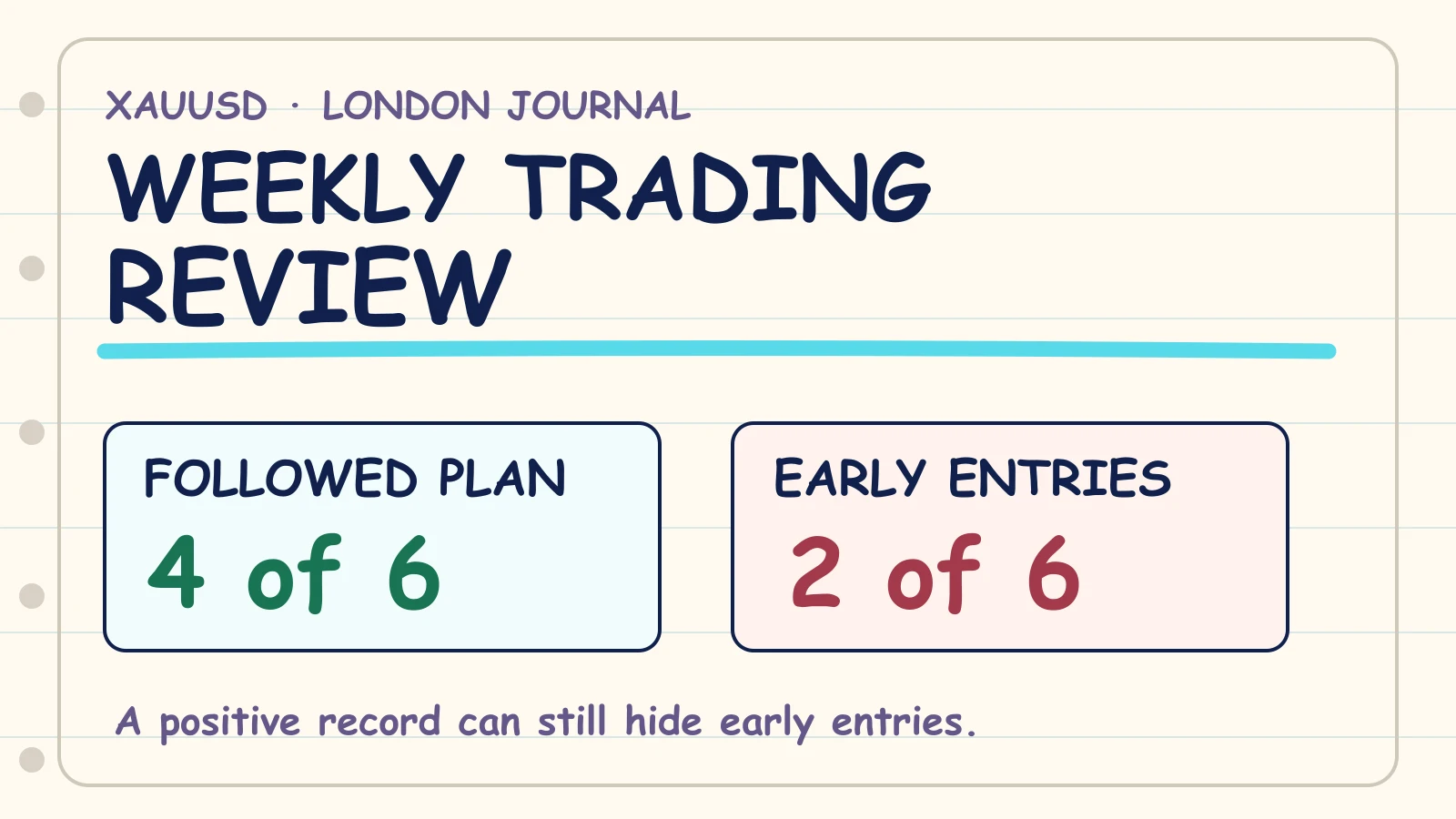
Trading Journaling
Monthly Trading Review Template: Compare Your Weeks
Copy a short monthly trading review sheet, compare four weekly notes, and see a filled XAUUSD example that keeps your plan-following separate from P&L.
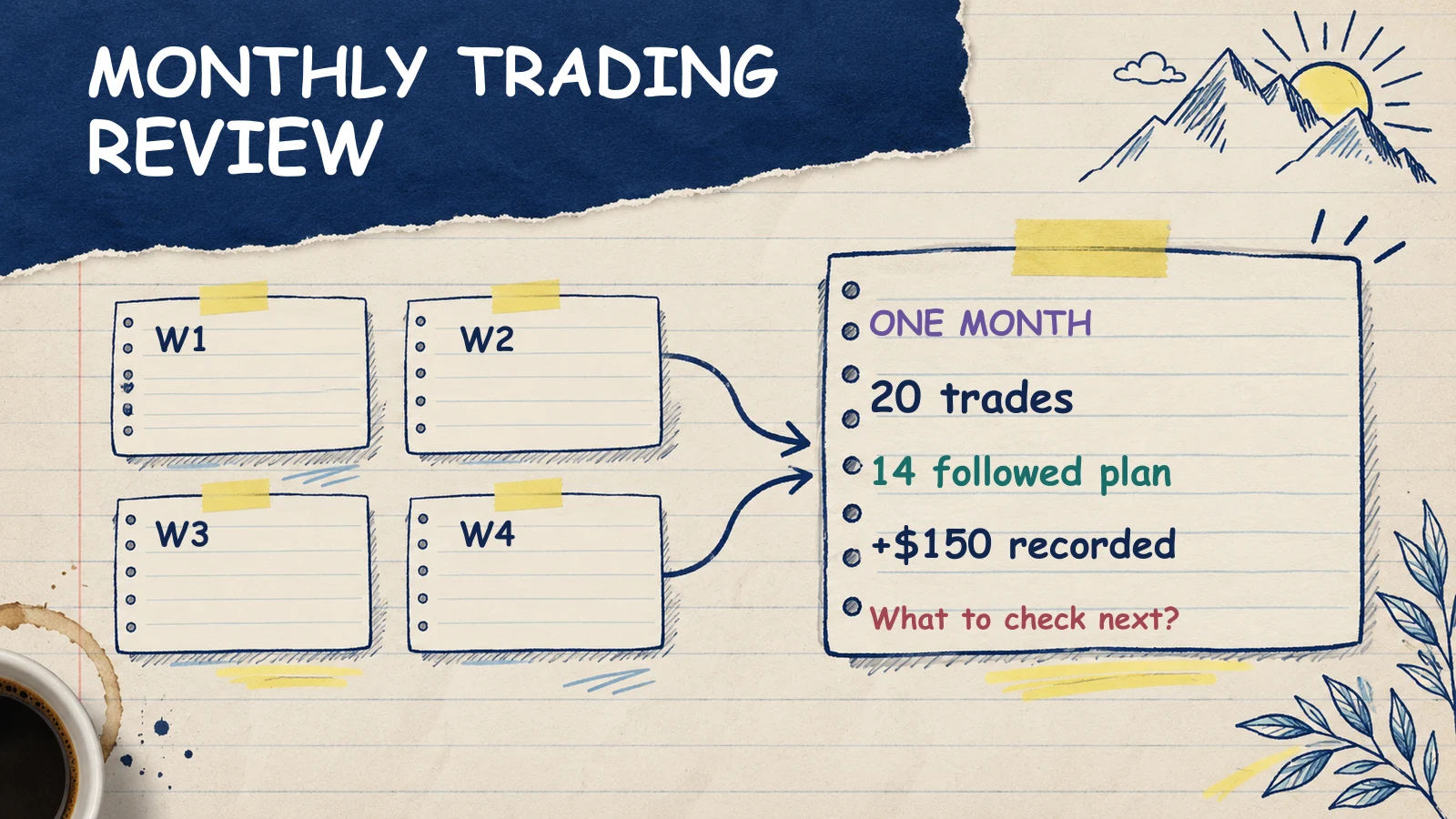
Your month shows +$150 in your records. That feels good. But when you look at the trades, you remember entering before your own check was complete. Did you follow your plan more often this month? Which decision should you look at next month?
You cannot answer that from the dollar result alone. Open your weekly notes and compare what you planned, what you did, and what you recorded. A monthly trading review template gives those notes one place to meet.
Quick answer: copy the short sheet below. Use your weekly records to add trade counts, how many entries followed the same written check, and the recorded dollar results. Look back at the individual trades before calling something a repeated habit. End with one question to check next month. If a field was not recorded, write that instead of guessing.
Copy this monthly trading review template
You can put these prompts in a document or your trading journal. A trade review means looking back at recorded decisions and results to learn what to check next. This sheet is a suggested review habit, not a form your prop firm requires.
Month and account: ______
Setup and the written check I am comparing: ______
Weeks and trade records covered: ______
Trades that followed that check: ______ of ______ recorded trades
Recorded USD result and fee status: ______
Decision I noticed more than once, with the trade records to check: ______
Missing or uncertain records: ______
One question for next month’s records: ______
Start with your weekly trading review notes if you have them. You can still make a monthly sheet without four complete weeks. Just say which weeks and trades it covers. Do not fill a gap from memory as though it were a recorded fact.
Compare the same written check across weeks
Here is a fictional month of XAUUSD trades during the London session. XAUUSD means gold priced in US dollars. The trader planned a breakout, meaning a move beyond a level they marked. For these example trades, their own written entry check was wait for the breakout candle to close beyond that level. A candle is one price bar for the time period the trader chose. This is an example of reviewing a plan, not a trade instruction.
Each weekly note counts only trades with that same setup and check. “Followed” means the record shows the trader waited for their required close. The dollar results are the fictional amounts entered in the journal. Fees were not recorded, so the table does not call them net profit. On a phone, swipe the table sideways to read each column.
| Week | Comparable trades | Followed written check | Recorded USD result |
|---|---|---|---|
| 1 | 5 | 4 of 5 | +$60 |
| 2 | 5 | 3 of 5 | +$100 |
| 3 | 6 | 5 of 6 | −$40 |
| 4 | 4 | 2 of 4 | +$30 |
| Month | 20 | 14 of 20 | +$150 |
The arithmetic is simple: 5 + 5 + 6 + 4 = 20 trades; 4 + 3 + 5 + 2 = 14 entries followed the written check; $60 + $100 − $40 + $30 = +$150 recorded before fees that this example did not capture.
Week 2 made +$100, yet two of its five entries did not follow the written check. Week 3 lost $40, yet five of six did follow it. The money and the plan answer different questions. Week 4 had only four comparable trades, so do not treat its 2 of 4 as a stable score or a forecast.
Check the trades behind the weekly numbers
The weekly counts tell you where to look. They do not tell you why an entry happened. Open the original entries and screenshots if you have them. In this fictional journal, Week 2 trades 2 and 5, and Week 4 trades 1 and 4, say the trader entered before the candle closed. That action appears in more than one week. It is a recorded observation, not proof that early entry caused any week’s result or that the next trade will behave the same way.
If an entry has no clear action note, mark “not recorded”. Do not quietly count it as followed or broken. If you changed your written rule partway through the month, separate the trades made under each version instead of judging them all against one rule. A month with just a few comparable trades may give you not enough records yet; that is a useful, honest result.
If you want to understand a ratio such as win rate or profit factor later, the trading performance metrics guide explains what those numbers can and cannot say. You do not need them to fill this first monthly sheet.
See one completed monthly sheet
This is what the fictional trader can now write from the four weekly notes and the checked entries:
Month and account: One fictional month; one example prop-firm account.
Setup and written check: XAUUSD London breakout; wait for the breakout candle to close beyond the marked level.
Weeks and trade records covered: Four weeks; 20 comparable recorded trades.
Trades that followed that check: 14 of 20.
Recorded USD result and fee status: +$150; fees were not recorded, so this is not a net figure.
Repeated observation: Early-entry notes in Week 2 trades 2 and 5, and Week 4 trades 1 and 4. Reopen those entries to check exactly what happened.
Missing or uncertain records: Fee amounts were not captured. No firm-rule verdict is recorded here.
One question for next month’s records: On each comparable breakout, did I wait for the close required by my written plan?
The sheet does not say “this setup stopped working,” “the account is safe,” or “the firm rule was breached.” Those claims need different evidence. If you trade a prop-firm account, check the current terms and dashboard for your exact firm, program, stage and account. Your review note is not the firm’s official status.
Use the next month to check, not to predict
Keep the final question beside your normal trade notes. When the same planned setup comes up again, write whether you followed the check you had before the entry. At the next review, compare the recorded actions. This is more useful than declaring a permanent “pattern” from four small weekly groups.
The broader prop-firm trading journal guide helps you keep the underlying records. If you want to look at days rather than weekly notes, the P&L calendar guide has a different job: seeing recorded results by day. A calendar colour alone cannot explain whether you followed a written plan.
PropLogAI lets you manually log trades, notes, emotions and whether you followed your own rules. Its journal can hold the records you use for this review. The worksheet here is an educational example; it does not imply that this exact monthly sheet or a four-week comparison is built into the app. You still decide what the records mean.
Start your trading journal
Track trades, understand your psychology, and get personalized AI coaching. No signals, no financial advice — just better self-review from your own data.
Get Started Free