Trading Discipline
Trading Discipline Checklist for Prop Firm Traders
Use a simple before-session, pre-trade, post-loss and end-of-day discipline checklist with a clear XAUUSD example for prop-firm traders.
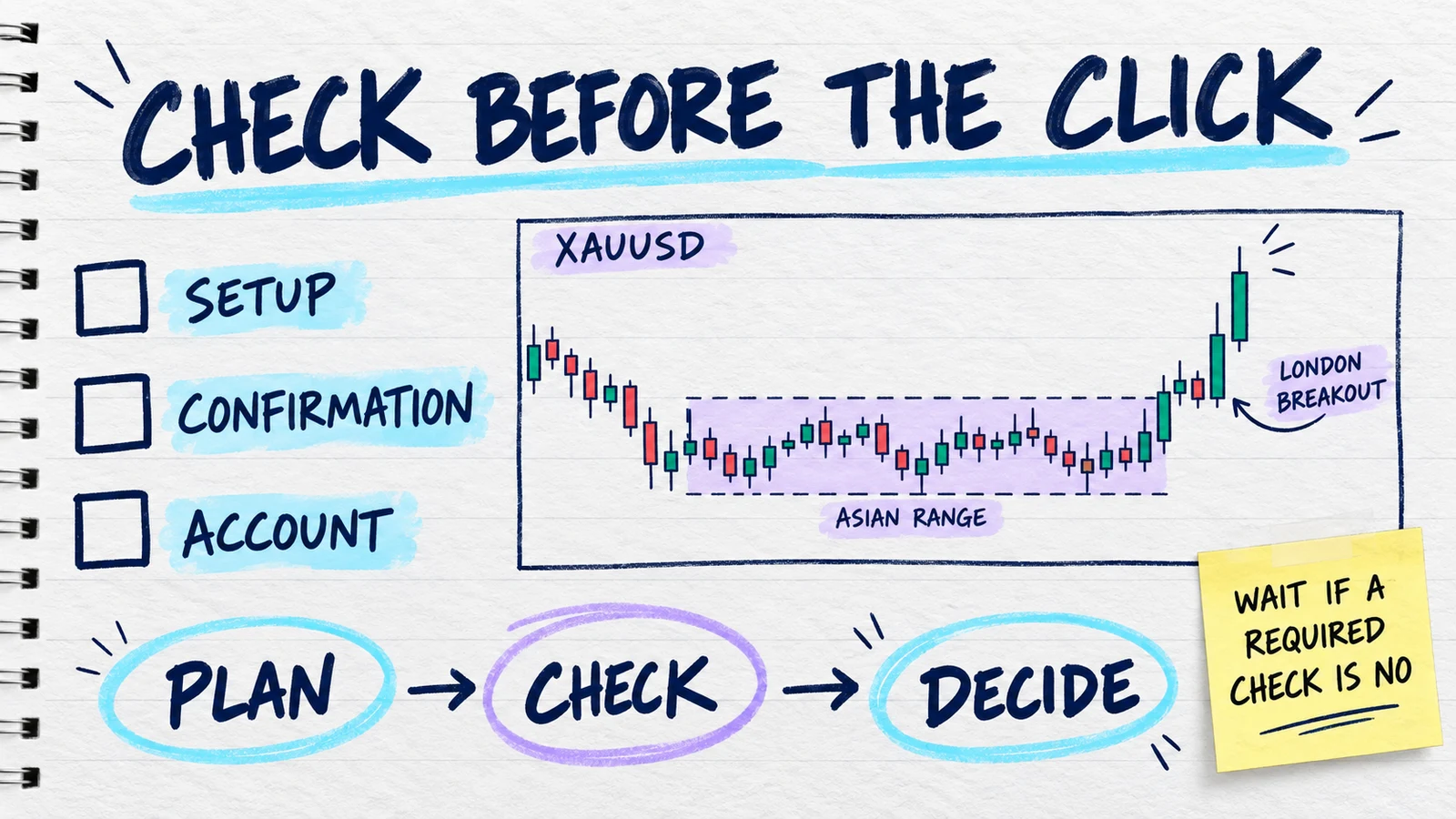
XAUUSD moves above the Asian-session high during London. You recognise your breakout setup and feel ready to enter.
Before you click, can you confirm the setup, candle close, account state, normal size and reason without changing your rules?
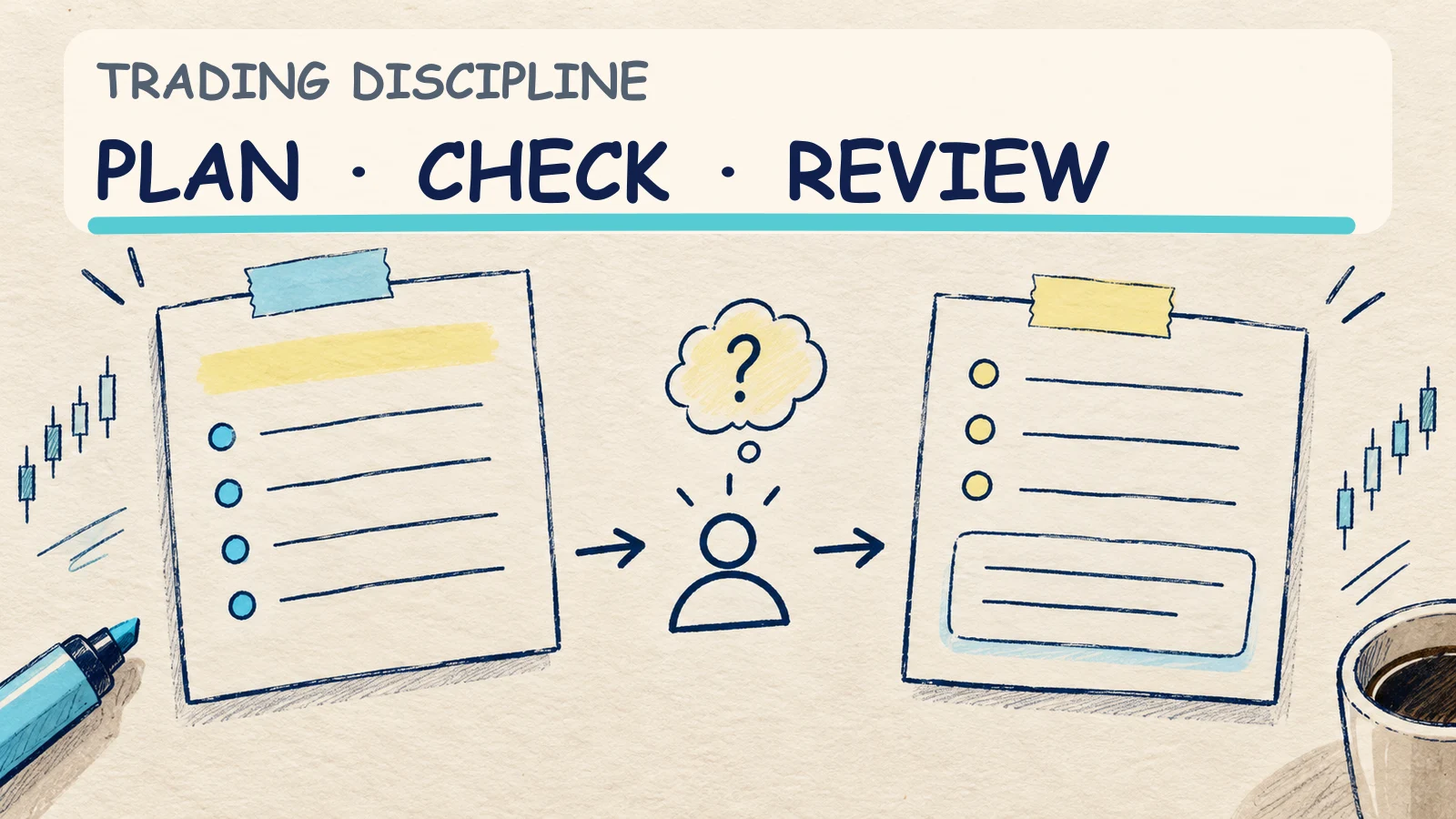
Quick answer: Use four short checks: before the session, before the trade, after a loss or strong urge, and at the end of the day. Mark each required item Yes, No or Not checked. A required No means the decision does not match your current written plan. The checklist does not tell you whether the trade will win.
This checklist is the quick-use companion to the complete trading discipline system. If you still need to write your rules, begin with the prop-firm trading rulebook guide.
What do the three checklist results mean?
| Result | What it means | What you do next |
|---|---|---|
| Ready for your own decision | Every required personal and account check is complete | Make your own decision. This result is not a signal and does not predict a win. |
| Wait | A required confirmation or factual check is incomplete | Do not treat an unfinished check as complete. |
| Stop and review your plan | A required personal rule or current official account condition is not met | Return to your written plan and the official rules for your exact account. |
The first result does not mean “approved trade” or “safe trade.” It only means that you completed the process you had written down.
1. Before the session
Do this before price starts pulling your attention from one decision to another.
- Account: Did you check the exact firm, program, account stage and current dashboard?
- Instrument and session: Did you write the instrument and session you plan to trade?
- Setup: Did you name the setups you will accept today?
- Sizing method: Is your normal documented method available before an entry appears?
- Loss response: Did you write what you will check after a loss, missed move or strong urge?
- Official restrictions: Did you check any current restriction that matters to this exact account at the firm’s official source? Use the prop-firm rules guide when you need a clear way to separate the firm, program and account stage.
- Personal stop condition: Did you record any distraction or physical condition that your own plan treats as a reason to stop?
Your trading plan should provide these answers. The checklist should help you use that plan; it should not invent the rules for you.
2. Before the trade
You may feel an urge to enter when price starts moving. Read the checks slowly enough to answer what is true now.
- Does the instrument match the plan?
- Is the trade inside the planned session?
- Is the named setup present?
- Is every required confirmation complete?
- Is the invalidation or stop condition written before entry?
- Does the size come from the normal documented method?
- Is the account state inside the current official limits for this exact program and stage?
- Can you explain the reason without FOMO, recovery language or a guess about the outcome?
This is a setup-compliance check: you compare the idea in front of you with the conditions written before it appeared.
A clear XAUUSD example
Imagine a trader has this fictional plan:
- instrument: XAUUSD;
- session: London;
- setup: an Asian-session liquidity sweep followed by a breakout;
- confirmation: the breakout candle must close; and
- size: the trader’s normal documented method.
A liquidity sweep here means price briefly moves beyond a marked high or low. A breakout candle close means the candle has finished beyond the level required by this fictional plan. These descriptions explain the example; they do not recommend this setup.
Price moves above the Asian-session high, but the breakout candle is still open.
Instrument matches the plan: Yes
London session: Yes
Named setup present: Yes
Required breakout candle closed: No
Account dashboard checked: Yes

Checklist result: Wait
The trader waits because their own required confirmation is incomplete. This is not a buy or sell signal. If a fresh setup appears later, the trader runs every required check again.
3. After a loss, missed move or strong urge
Suppose the previous XAUUSD trade ended at −$50. Price moves again, and you feel that you should enter quickly.
Pause new entries while you record the facts. Then ask:
Would I take this exact trade if the last result were
$0?
Check these five parts:
- Setup: Is this a completely new named setup?
- Confirmation: Are the same normal confirmations complete?
- Session: Are you still inside the session written before trading began?
- Size: Are you using the same documented sizing method?
- Reason: Can you explain the trade without saying “win it back,” “one more,” or “I missed it”?
Apply the loss-response rule you wrote before the session. If your plan and the current firm rules allow another trade, require a completely new setup that passes the normal checks. The detailed revenge-trading workflow explains how to review a decision driven by recovery. The overtrading guide covers repeated entries and other process drift.
There is no universal cooldown, maximum loss count, daily trade count, smaller-size rule or stop-for-the-day rule that fits every trader and program. Use your own prewritten rule and the firm’s current official terms.
4. At the end of the day
The result in dollars does not tell you whether you followed your process. Review the process separately.
- Record planned trades and actual trades separately.
- Record profit or loss in USD, but do not use P&L as the discipline score.
- Record rule adherence, setup compliance, emotion or urge, and screenshots.
- Identify one decision that followed the plan.
- Identify one decision that changed from the plan.
- Save any proposed rule change for a later review instead of rewriting a rule immediately after one result.
Rule-based trading means using conditions you can observe and review. It does not mean that every rule produces a winning trade.
Copy this one-page trading discipline checklist
BEFORE THE SESSION
[ ] Exact firm, program, account stage and dashboard checked
[ ] Instrument and planned session recorded
[ ] Named setups recorded
[ ] Normal sizing method available
[ ] Loss-response rule available
[ ] Current official restrictions checked at the source
[ ] Personal stop conditions recorded

BEFORE THE TRADE
[ ] Instrument and session match the plan
[ ] Named setup is present
[ ] Required confirmation is complete
[ ] Invalidation or stop condition is written
[ ] Size uses the normal documented method
[ ] Account state is inside the exact official limits
[ ] Reason is clear without FOMO or recovery language

AFTER A LOSS, MISSED MOVE OR STRONG URGE
[ ] Next entry paused while facts are recorded
[ ] Asked: Would I take this if the last result were $0?
[ ] Setup, confirmation, session, size and reason checked
[ ] Prewritten loss-response rule applied
[ ] Completely new valid setup required if another trade is allowed

END OF DAY
[ ] Planned and actual trades recorded separately
[ ] Profit or loss recorded in USD
[ ] Rule adherence and setup compliance recorded
[ ] Emotion or urge and screenshots recorded
[ ] One followed decision and one changed decision identified
[ ] Proposed rule changes saved for later review

RESULT
[ ] Ready for your own decision
[ ] Wait
[ ] Stop and review your plan
You can paste this into a notebook, spreadsheet or the trading journal template.
How to review the answers without judging by P&L
A planned trade can lose. An unplanned trade can win. So review the decision in this order:
- What did the written plan require?
- Which checks were complete before entry?
- Which check was marked No or Not checked?
- Did the decision change after a loss, missed move or strong feeling?
- Did the official account state affect what was allowed?
- What single process question should you review later?
Do not rewrite the rulebook because one trade lost. Collect enough records to see whether the same change repeats. This keeps the checklist connected to the process rather than the latest outcome.
How PropLogAI fits into the checklist
PropLogAI lets you manually record trade details, notes, emotions, rule adherence and screenshots. It can help you review patterns in the journal data you enter. It does not check the live market, verify a prop-firm dashboard, provide signals, approve a trade, block an order or guarantee discipline.
The checklist remains fully usable in a notebook or spreadsheet.
Frequently asked questions
What should be on a trading discipline checklist?
Include the account and official rules, planned instrument and session, named setup, required confirmation, invalidation, normal sizing method, decision reason, post-loss response and end-of-day record. Use the checks that belong to your written plan and exact account.
Does completing the checklist mean the trade is safe?
No. A completed checklist means the required process checks are complete. It does not validate the market idea, remove risk, predict a win or approve the trade.
What should you check after a losing trade?
Check whether the next setup, confirmation, session, size or reason changed. Ask whether you would take the same trade if the previous result were $0. If recovery becomes the purpose, read the definition of revenge trading.
Should every trader use the same stop rule?
No. Write your own stop and loss-response rules before the session, and follow the current official terms for your exact firm, program and account stage.
Can PropLogAI approve or block a trade?
No. PropLogAI can help you record and review the journal information you enter. It does not read the live market, approve a decision or block an order.
Sources and limits
Zerodha Varsity’s trading checklist lesson supports comparing a considered trade with predefined conditions. Its examples do not prove profitability or create universal rules for every prop-firm account.
Educational material from Zerodha Varsity and OANDA provides general context on emotion and decision-making. It does not diagnose you or prove that one feeling caused one result.
Always check the firm’s current official rules and dashboard for account-specific facts. A checklist can make your process visible. It cannot guarantee the market result.
Start your trading journal
Track trades, understand your psychology, and get personalized AI coaching. No signals, no financial advice — just better self-review from your own data.
Get Started Free